If you are searching for an I-130 lawyer, you are usually in one of two situations. Either you want to file a strong marriage petition the first time, or the U.S. Citizenship and Immigration Services (USCIS) has already asked for more proof and you want to respond the right way.
Form I-130 is not the full green card process. However, it often sets the tone for everything that follows. When you present a clear relationship story, consistent facts, and organized evidence, you reduce the odds of delays, Requests for Evidence (RFEs), and credibility problems later.
This guide explains what an I-130 lawyer focuses on in a marriage petition, what evidence is most important, what triggers common RFEs, and what happens after approval.
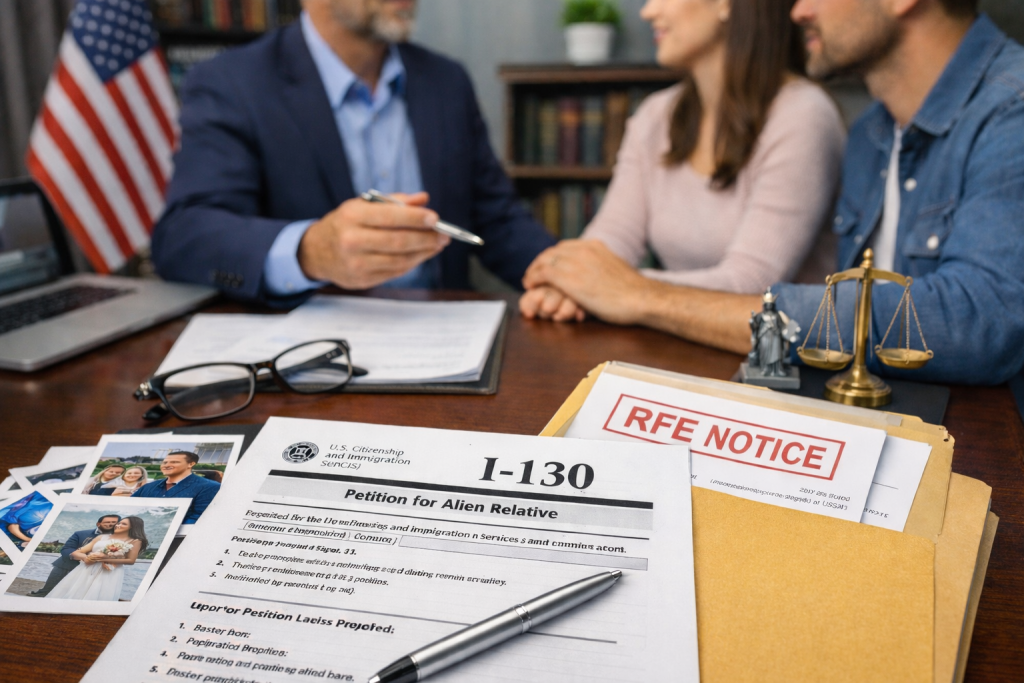
What Form I-130 proves (and what it does not)
In a marriage case, Form I-130 aims to prove two core points:
- The petitioner qualifies to sponsor a spouse.
- The marriage is legally valid and real.
USCIS summarizes Form I-130’s purpose, filing basics, and related resources on its Form I-130 page.
An approved I-130 does not automatically grant lawful status, a work permit, or travel authorization. It also does not guarantee the final green card approval. Instead, it moves you into the next stage, which depends on where the foreign spouse will apply.
When an I-130 lawyer adds the most value in a marriage case
Many couples can file an I-130 successfully. Even so, an I-130 lawyer tends to add the most value when any of the following apply.
Your case has “review triggers”
These facts do not mean the marriage is not real. Still, they can push USCIS to look closer.
- Prior marriages for either spouse.
- Prior immigration filings, petitions, or denials.
- Short courtship or marriage soon after meeting.
- Large age difference, major cultural differences, or language barriers.
- Long-distance marriage or long periods living apart.
Your documents do not “line up” cleanly
Marriage cases often get RFEs because the record has inconsistencies, not because the relationship is fake.
- Different addresses across forms and supporting documents.
- Different dates for key events (meeting, engagement, marriage, moves).
- Name spelling variations, transliteration issues, or missing name-change proof.
You already received an RFE or NOID
At that stage, the response structure matters as much as the documents. A good response makes it easy for an officer to verify each claim quickly.
I-130 lawyer evidence strategy: build your packet in “buckets”
USCIS officers do not only count documents. They assess whether your evidence tells a coherent story. A practical I-130 lawyer usually organizes a marriage petition into evidence “buckets” so the file reads like a timeline, not a pile of paper.
You do not need every item in every bucket. Instead, aim for credible coverage across buckets that match your real life.
Bucket 1: Identity and eligibility evidence
This bucket supports the basics: who you are and why the petitioner can file.
- Proof the petitioner is a U.S. citizen or lawful permanent resident.
- Government-issued IDs for both spouses.
- Name-change records, if any, so the documents match.
Bucket 2: Proof the marriage is legally valid
This is the civil-document foundation of the petition.
- Marriage certificate.
- Divorce decrees, annulment orders, or death certificates from any prior marriages.
Missing divorce documentation is a common RFE trigger. If you have prior marriages, make this bucket clean and easy to review.
Bucket 3: Shared residence and daily life
Many genuine couples prove their relationship best through ordinary life documents.
- Joint lease or mortgage.
- Utility bills showing both names at the same address.
- Mail addressed to each spouse at the shared residence across time.
If you do not live together for a legitimate reason, you can still build a strong petition. However, you should explain the reason clearly and increase evidence in other buckets.
Bucket 4: Shared finances and responsibilities
Financial evidence often carries weight because it tends to reflect long-term commitment.
- Joint bank statements showing real use.
- Joint tax filings, if appropriate for your situation.
- Insurance policies naming each other as beneficiaries.
- Shared loans, credit accounts, or major purchases.
If you do not merge finances, do not try to “force” it at the last minute. Instead, build strength through housing, social proof, travel, communications, and affidavits, and explain your real-world arrangement.
Bucket 5: Social proof and relationship timeline
This bucket is where many couples overdo quantity and lose clarity. A smaller set of well-chosen exhibits often works better than hundreds of uncaptioned photos.
- Photos across time, not only one trip.
- Travel records that match your story.
- Messages or call logs that show ongoing contact, especially for long-distance periods.
- A short relationship timeline that ties your exhibits together.
Bucket 6: Affidavits from people who know you as a couple
Affidavits can help, especially for non-traditional arrangements. Still, they should support documents, not replace them.
- Keep affidavits specific, factual, and consistent.
- Avoid exaggeration or “perfect” scripted language.
- Match affidavit details to your timeline and records.
What USCIS tends to look for in spousal evidence
USCIS discusses marriage-based relationship evidence concepts in the USCIS Policy Manual guidance for spouses.
In practical terms, USCIS usually looks for evidence that:
- Covers time, not just one moment.
- Shows shared life and shared decisions.
- Matches the story told in the forms.
- Does not conflict with prior records.
A good I-130 lawyer thinks like a reviewer. The goal is to make the petition easy to approve without guessing.
I-130 lawyer “consistency audit”: prevent the most common avoidable problems
Many marriage petition RFEs are avoidable. They happen because the forms and documents do not align.
Before filing, a careful I-130 lawyer typically checks consistency across:
- Names, spelling variations, and prior names.
- Dates for meeting, engagement, marriage, and major moves.
- Addresses for the last several years.
- Prior marriages and how they ended.
- Prior immigration filings and travel history, if relevant.
- Children, shared parenting, and household structure.
A simple rule helps: if you claim a fact in one place, support it or explain it everywhere else it appears.
Common I-130 RFEs in marriage cases
USCIS uses RFEs to request missing items, clarify inconsistencies, or ask for stronger proof. Below are common RFE patterns and how an I-130 lawyer typically responds.
Missing civil documents
USCIS may request:
- A clearer copy of the marriage certificate.
- Proof all prior marriages ended legally.
- Proper English translations for foreign-language documents.
If you respond, provide a clean exhibit list and label each civil document clearly.
Insufficient proof the marriage is bona fide
This is the classic marriage RFE. USCIS often asks for more evidence of a shared life, such as:
- Joint housing records.
- Joint financial documents.
- Insurance, beneficiaries, or shared obligations.
- Time-based proof across the relationship.
If you already included some of this, the issue is often organization. In that case, restructure your response by bucket and show coverage across time.
Inconsistencies or unclear timeline
USCIS may ask you to reconcile:
- Different addresses across forms.
- Conflicting “how we met” narratives.
- Gaps in cohabitation without a clear explanation.
- Name variations that make documents look unrelated.
In these RFEs, a short written explanation matters. You should explain the discrepancy, show the corrected fact, and attach proof.
Prior immigration history concerns
If USCIS sees prior petitions, overstays, or other complications, it may ask for:
- Copies of earlier filings or decisions.
- Clarification of status history.
- Evidence that the current marriage is independent and genuine.
If you have prior issues, avoid casual explanations. Stick to facts, include supporting records, and keep the response consistent with the official history.
Filing and next-step planning (avoid delays)
Even strong evidence can face delays if you file incorrectly. Since USCIS updates routing and addresses over time, confirm the current guidance on the official Form I-130 filing addresses page.
Also, keep your packet easy to review by using a simple table of contents, clear exhibit labels, and short dividers. After approval, most couples move into one of two paths—adjustment of status in the United States or consular processing abroad—depending on where the beneficiary will apply and whether they qualify to file inside the United States.
Path 1: Adjustment of status in the United States
If your spouse is eligible to apply for a green card from inside the United States, the next step is usually adjustment of status. That stage centers on Form I-485 and related filings, and USCIS will compare the facts in your I-485 packet to what you already submitted with your I-130. Because of that, it is important that your dates, addresses, and relationship timeline stay consistent across the entire record.
If you want a step-by-step overview of the adjustment process, see our guide on Adjustment of Status Lawyer: I-485 Steps.
Path 2: Consular processing abroad
If the foreign spouse will complete the case outside the United States, the approved petition typically moves into Department of State processing through the National Visa Center (NVC) before the interview.
The State Department explains the NVC stage and document review on its NVC overview.
Consular processing creates a second record of your case. Because of that, consistency remains critical. The timeline, addresses, and prior history should match what you filed with USCIS.
How this guide fits with the full marriage-based green card process
This page focuses on the Form I-130 petition stage—how to document a real marriage, reduce RFE risk, and keep your facts consistent across the record.
If you want the full, start-to-finish marriage green card overview, including I-130 and I-485 timing, Form I-864 financial sponsorship, and interview preparation, see our complete guide.
Conclusion
A strong marriage petition does not rely on volume. It relies on clarity. A good I-130 lawyer approach is simple: organize evidence into buckets, keep facts consistent across the record, and make the packet easy for an officer to verify.
If you build a clean petition the first time, you reduce delays and keep the case positioned for the next step, whether you adjust status in the United States or finish through consular processing abroad.
Disclaimer: This page provides general information, not legal advice. Immigration rules and procedures change. Always rely on current instructions from USCIS and the U.S. Department of State (linked above) and consult a qualified attorney about your specific situation.
Leave a Reply