A green card can expire, get lost, or come back from the U.S. Citizenship and Immigration Services (USCIS) with a typo. When that happens, most lawful permanent residents fix the problem with Form I-90. This guide explains what an I-90 lawyer does, when Form I-90 is the right tool, and how to file in a way that avoids slowdowns and mistakes.
If you want a broader roadmap for green card strategy beyond Form I-90, see our green card lawyer guide.
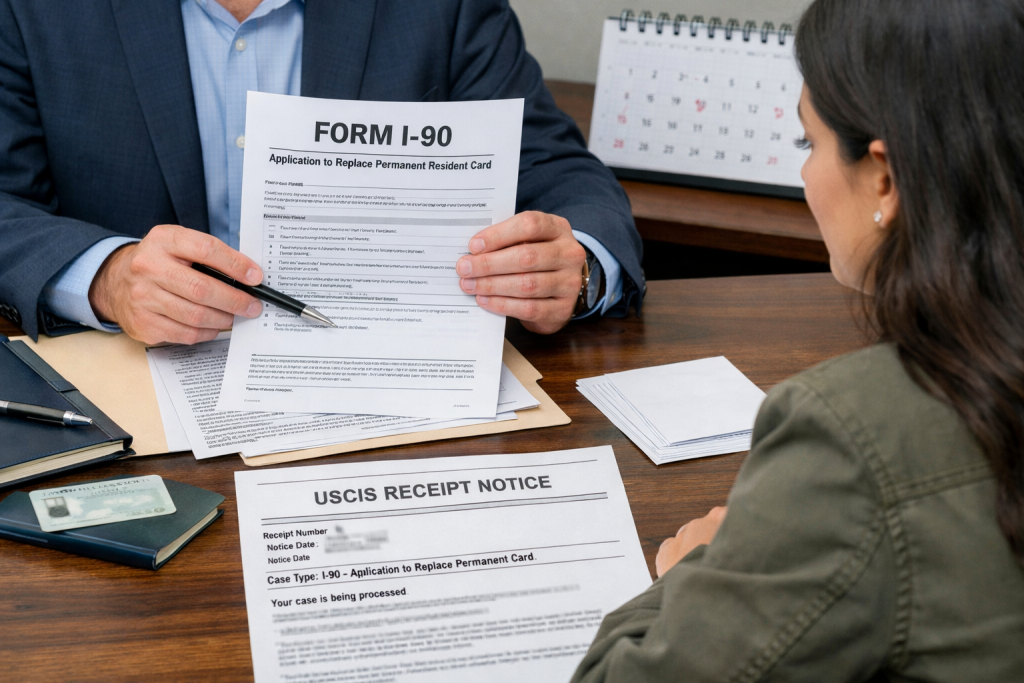
What does the Form I-90 do and when does an I-90 lawyer help?
Form I-90 is the USCIS application used to renew or replace a Permanent Resident Card (also called a Green Card). You can use it for issues like:
- A 10-year green card that will expire soon (renewal)
- A card that is lost, stolen, or damaged (replacement)
- A card with incorrect information due to a USCIS error (correction)
- A legal name change that you want reflected on the card (replacement).
Many people file Form I-90 without an attorney. Still, an I-90 lawyer can add real value when your case has any friction, such as:
- You have a 2-year conditional card and you are not sure whether you should file I-90 or a petition to remove conditions.
- You need proof of status quickly for work, travel, or a driver’s license renewal.
- You never received the card, and you need the right escalation path instead of filing the wrong form.
- You have a prior immigration issue, a removal order, or a criminal history, and you want to avoid triggering a preventable problem.
For the official USCIS starting point, use the Form I-90 page.
First decision: Do you need Form I-90 or a different filing?
Before you spend time and money, make sure you are choosing the correct process.
If you have a 10-year green card
In most cases, Form I-90 is the correct filing for renewal or replacement.
If you have a 2-year conditional green card
This is where people make expensive mistakes.
If your 2-year card is close to expiring, USCIS typically expects you to file a petition to remove conditions (often Form I-751 for marriage-based conditional residents, or Form I-829 for EB-5 conditional residents). In other words, you usually do not “renew” a conditional card with Form I-90 right before it expires.
An I-90 lawyer will usually confirm your card type first, then map the correct filing, so you do not lose time on the wrong application.
If you may be eligible for naturalization
Some permanent residents decide that citizenship is the better long-term move than repeated renewals. Even if you still need a valid card right now, it can be smart to check whether naturalization is realistic for you so you plan with intent.
Renew vs replace: the “reason for filing” matters more than people think
USCIS does not treat every I-90 the same. The reason you select drives:
- The evidence you must attach
- The fee category
- The type of follow-up USCIS may request.
This is also where an I-90 lawyer can prevent avoidable delays. A clean filing usually matches the reason, the evidence, and the narrative.
Common examples include:
- Expiring 10-year card. You typically file as a renewal and attach a copy of the current card.
- Lost or stolen card. You file as a replacement and explain the facts clearly, then attach the best available identity and status evidence.
- Damaged card. You submit the damaged card if you still have it, plus an explanation of how it got damaged.
- Incorrect biographic data because of a USCIS error. You document the error and include supporting records. This category can differ from “my info changed.”
- Legal name change. You attach proof of the legal name change and keep your filing consistent with your IDs.
I-90 lawyer roadmap: how to file Form I-90 with fewer surprises
Step 1: Confirm the goal and confirm your card type
Start with the basics:
- Are you a lawful permanent resident with a 10-year card?
- Are you a conditional resident with a 2-year card?
- Are you correcting a USCIS error, or did your information change?
Do not skip this. Many delays start here.
Step 2: Build a simple evidence packet
Most I-90 filings rely on a short set of documents, such as:
- A copy of the front and back of your current card (if you still have it)
- Proof of legal name change (if that is the reason)
- Government-issued photo ID (helpful when the card is lost).
Keep evidence relevant. Extra documents that do not match the filing reason can slow review.
Step 3: Pay the correct fee the first time
USCIS rejects filings for incorrect fees. Also, Form I-90 fees can vary based on the reason for filing.
Use the USCIS Fee Calculator for the current amount that matches your reason.
Step 4: File and track your case like a project
After you file, you should:
- Save your receipt notice
- Track the case online
- Watch your mail and your USCIS account for requests.
USCIS case tracking starts here.
Step 5: Biometrics and follow-ups
Many I-90 cases include a biometrics step. If USCIS requests more information, respond with a tight, organized packet that answers exactly what they asked for.
An I-90 lawyer often helps most at this stage, because a weak response can add months.
While you wait: proof of status, work, and travel realities
A common fear is: “My card expires, so do I lose my status?” In general, lawful permanent resident status does not automatically end just because the card expires. Still, an expired card can create real-life problems with employers, DMVs, and airlines.
In many renewal cases, USCIS issues a receipt notice that can extend the validity of an expiring card for a period of time. Do not assume the extension language. Read your receipt notice carefully and use the exact wording it provides.
If you have urgent travel needs or you are outside the United States, you need to plan even more carefully. Long trips can trigger bigger issues than an I-90 renewal.
For the State Department’s overview of “returning resident” situations after long absences, start here.
Common I-90 delays an I-90 lawyer tries to prevent
Most slowdowns come from avoidable mistakes:
- Filing I-90 when you instead needed a petition to remove conditions
- Choosing the wrong reason and attaching mismatched evidence
- Using inconsistent names, dates, or addresses across forms and IDs
- Paying the wrong fee category
- Missing a biometrics notice or failing to respond to a USCIS request cleanly.
An I-90 lawyer’s job is to make the case boring: consistent facts, correct category, correct fee, and a packet that reads clearly.
When to talk to an I-90 lawyer quickly
Consider a consultation if:
- You have a 2-year conditional card and the expiration date is approaching.
- You need proof of status fast for a job, international travel, or a time-sensitive benefit.
- USCIS says the card was delivered, but you never received it.
- You have prior immigration violations, criminal history, or a complicated travel history.
Conclusion
Form I-90 looks simple, but the details control the timeline. A good I-90 lawyer approach is about choosing the correct process, matching the reason to the evidence, paying the right fee, and protecting you from downstream problems while you wait for a new card.
Disclaimer: This page provides general information, not legal advice. Immigration rules and procedures change. Always rely on current instructions from USCIS and the U.S. Department of State (linked above) and consult a qualified attorney about your specific situation.
Leave a Reply