Receiving a Request for Evidence can feel stressful, especially when your immigration case already took months to prepare. However, an RFE does not automatically mean USCIS plans to deny the case. It usually means the officer needs more documents, clearer proof, or an explanation before making a final decision. That said, an RFE is not something to treat casually. The deadline matters. The wording matters. The missing evidence matters. Most of all, the response must answer the actual request, not just add more papers and hope for the best. An RFE lawyer helps by reading the notice carefully, identifying what USCIS is really asking for, organizing the response, and reducing the risk of an incomplete or confusing submission.
This guide explains how USCIS Requests for Evidence work, what common mistakes to avoid, and when legal help may be especially important.
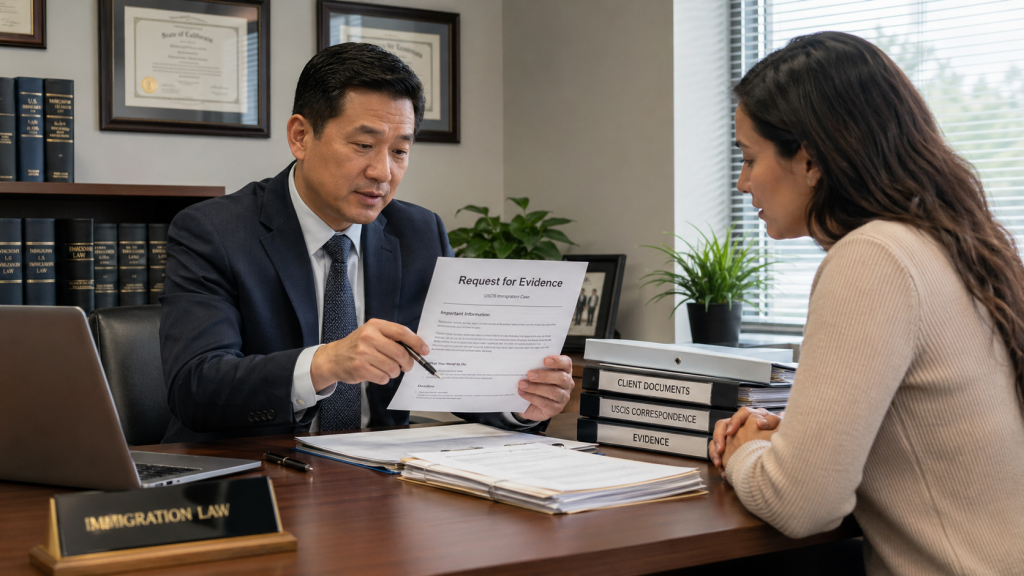
What is a USCIS Request for Evidence?
A Request for Evidence, often called an RFE, is a written notice from U.S. Citizenship and Immigration Services asking for more information before USCIS decides an application or petition.
USCIS may issue an RFE when the original filing is missing required evidence, when the evidence is not clear enough, or when the officer needs more proof on a specific legal requirement. USCIS discusses evidence review and Requests for Evidence in its official Policy Manual guidance on evidence.
An RFE is different from a denial. It gives the applicant, petitioner, or requestor a chance to fix the record before USCIS makes a final decision. However, that chance has limits. If the response is late, incomplete, or poorly organized, USCIS may deny the case based on the record it already has.
For that reason, the first step is not panic. The first step is careful reading.
Why USCIS sends RFEs?
USCIS sends RFEs for many reasons. Some are simple. Others are serious.
A basic RFE may ask for a missing birth certificate, a clearer copy of a document, a certified translation, or a corrected version of a required form. In those cases, the response may be straightforward if the document exists and the applicant can provide it properly.
Other RFEs are more complex. USCIS may question whether a marriage is real, whether a job offer qualifies, whether a business has the ability to pay, whether a student maintained status, or whether a waiver case has enough hardship evidence.
Common RFE triggers include:
- Missing required initial evidence.
- Unclear copies of civil documents.
- Foreign-language documents without proper English translations.
- Inconsistent names, dates, addresses, or immigration history.
- Weak financial evidence.
- Insufficient proof of a real marriage or qualifying family relationship.
- Unclear job duties in a work visa or employment-based case.
- Missing medical exam documents in an adjustment of status case.
- Gaps between what the forms say and what the supporting documents show.
This is why an RFE lawyer does more than collect documents. A strong response should connect the evidence to the legal issue USCIS raised.
RFE lawyer strategy: read the notice before gathering documents
Many people respond to an RFE by immediately collecting every document they can find. That instinct is understandable, but it can create a messy response.
A better approach starts with the notice itself.
First, identify the form or petition involved. An RFE for Form I-130 is not the same as an RFE for Form I-485, Form I-129, Form I-140, Form I-539, or a waiver application.
Next, identify each issue USCIS listed. Some RFEs ask for one document. Others raise several separate issues. If the notice has three concerns and the response only addresses two, USCIS may treat the response as incomplete.
Then, check whether USCIS is asking for required evidence, stronger discretionary evidence, or clarification of a contradiction. These are different problems.
For example, if USCIS asks for a missing civil document, the response should provide the correct document or explain why it is unavailable and provide acceptable secondary evidence. However, if USCIS questions the credibility of a relationship timeline, the response should do more than submit another photo. It should explain the timeline and organize the proof so the officer can follow the story.
Watch the RFE deadline carefully
Every RFE has a deadline. The deadline printed on the notice controls the response plan.
Do not assume USCIS will give extra time. Do not wait until the last week to begin. Also, do not rely on mailing speed, scanner access, or third parties at the last minute. A good response takes time because the packet must be complete, labeled, and easy to review.
In some cases, USCIS may allow online submission through a USCIS online account. USCIS provides filing tips for online accounts, including responding to Requests for Evidence and uploading evidence, on its online filing tips page. However, the safest rule is simple: follow the exact instructions in the RFE notice.
If the notice tells you to mail the response, follow the mailing instructions. If the case account permits upload, make sure the upload is complete, readable, and correctly labeled. Keep proof of delivery, confirmation, or submission for your records.
How to organize a strong RFE response packet
A strong RFE response should make the officer’s job easier.
That means the response should not look like a random document dump. It should have structure.
A practical RFE response usually includes:
- A cover letter that identifies the applicant or petitioner, receipt number, form type, and RFE date.
- Short explanation of what the response includes.
- A table of contents or exhibit list.
- The RFE notice, if USCIS asks for it.
- Clearly labeled exhibits.
- Translations and translator certifications, when needed.
- Short explanation for any document that may confuse the officer.
The cover letter should not be emotional or argumentative. Instead, it should be direct. It should say what USCIS requested and where the answer appears in the packet.
For example, if USCIS asks for proof of a real marriage, the response may organize evidence into shared residence, shared finances, family recognition, travel history, communication history, and life events. If your issue is marriage-specific, our separate I-130 lawyer guide to marriage petition evidence and RFEs explains that type of evidence in more detail.
This new RFE response, however, should stay focused on the specific USCIS notice in front of you.
Common RFE issues in adjustment of status cases
Adjustment of status RFEs often involve Form I-485, financial sponsorship, medical exam documents, identity records, lawful entry, or eligibility concerns.
For many green card applicants, Form I-693 is a common issue. USCIS now gives important filing instructions on its official Form I-693 page, and applicants should always check the current version before filing or responding.
Other I-485 RFE issues may include:
- Missing birth certificate or unacceptable civil document.
- Missing passport page or I-94 record.
- Incomplete Form I-864 Affidavit of Support.
- Insufficient income or missing tax evidence from the sponsor.
- Questions about prior immigration violations.
- Missing divorce decrees or proof that prior marriages ended.
- Unclear criminal history records.
If your case is already near the interview stage, the same evidence issues may come up again. Our green card interview lawyer guide explains how USCIS interviews can lead to approval, further review, or a follow-up RFE.
Common RFE issues in family immigration cases
Family immigration RFEs often focus on identity, legal relationship, status, and consistency.
In spouse cases, USCIS may ask for stronger proof that the marriage is real. In parent, child, or sibling cases, USCIS may ask for birth records, adoption records, name-change documents, divorce decrees, or proof of the petitioner’s immigration status.
The key is to avoid treating all family RFEs the same.
A marriage RFE usually needs relationship evidence. A parent-child RFE may need civil records, legitimation evidence, custody documents, or proof of the legal relationship. A prior-marriage issue may require divorce decrees, annulment records, or death certificates.
If the case will later move through consular processing, civil documents also matter at the National Visa Center and interview stage. The U.S. Department of State explains immigrant visa civil-document requirements on its civil documents page.
Common RFE issues in work visa and employment-based cases
Work visa and employment-based RFEs often focus on whether the job, employer, beneficiary, and evidence match the legal category.
For example, USCIS may question whether a role qualifies as a specialty occupation in an H-1B case, whether an L-1 employee truly worked in a qualifying executive, managerial, or specialized knowledge role, or whether an O-1 petition proves extraordinary ability in the claimed field.
In employment-based green card cases, USCIS may ask about the employer’s ability to pay, the worker’s qualifications, the offered position, or the correct immigrant visa classification.
Our I-140 lawyer guide explains how employment-based green card petitions depend on category choice, documentary proof, and consistency between the petition and supporting record.
A strong RFE lawyer response in these cases usually does three things.
First, it defines the legal issue clearly.
Second, it links each document to that issue.
Third, it explains why the evidence satisfies the standard instead of assuming USCIS will connect the dots.
RFE vs. NOID: why the difference matters
An RFE and a Notice of Intent to Deny are not the same thing.
The RFE usually means USCIS needs more evidence before it can decide the case. A NOID is more serious. It often means USCIS has identified a reason it may deny the case unless the applicant or petitioner responds persuasively.
A NOID may involve credibility problems, derogatory information, suspected fraud, serious inconsistencies, or failure to meet a key legal requirement. Because of that, a NOID response usually needs more legal analysis than a basic document RFE.
Still, RFEs can also be serious. If the RFE asks for evidence on a central eligibility requirement, the case may depend on the response. Treat the notice according to the risk level, not according to the label alone.
Mistakes to avoid after receiving an RFE
The biggest mistake is missing the deadline. Once the deadline passes, USCIS may deny the case.
Another mistake is sending a partial response. If USCIS asks for several things, answer each item. If a document is unavailable, explain why and provide suitable alternative evidence when possible.
A third mistake is sending too much irrelevant material. More paper does not always mean a stronger response. In fact, a large disorganized packet can make the real evidence harder to find.
Avoid these common problems:
- Ignoring one part of the RFE.
- Sending blurry or incomplete copies.
- Forgetting certified English translations.
- Submitting documents that contradict the forms without explanation.
- Uploading files without clear labels.
- Using emotional statements instead of evidence.
- Sending a response without keeping a full copy.
- Waiting until the deadline is too close.
A good RFE response should be calm, complete, and organized.
When to hire an RFE lawyer
Not every RFE requires a lawyer. If USCIS only asks for a missing document and you can provide it clearly, the response may be simple.
However, legal help becomes more important when the RFE questions eligibility, credibility, lawful status, financial sponsorship, admissibility, business evidence, hardship, or prior immigration history.
Consider an RFE lawyer if:
- USCIS questions whether you qualify for the benefit.
- The RFE involves several legal issues.
- You already had a prior denial.
- Your case includes criminal, fraud, misrepresentation, or removal concerns.
- The evidence is weak or hard to obtain.
- Your documents contain inconsistencies.
- The RFE involves a marriage, waiver, work visa, or employment-based petition.
- You are not sure what USCIS is really asking for.
An RFE lawyer can also help when the facts are sensitive. In those cases, the response must do more than provide documents. It must explain the facts in a way that is accurate, consistent, and supported by the record.
Conclusion
A USCIS Request for Evidence is not a denial, but it should still be taken seriously. The response can strengthen the case, fix missing evidence, and clarify facts that USCIS did not understand from the original filing.
The best RFE responses are focused. They should:
- Answer the notice directly.
- Organize documents clearly.
- Meet the deadline.
- Avoid the mistake of overwhelming USCIS with irrelevant material.
If the RFE involves a simple missing document, the response may be straightforward. However, if the notice questions eligibility, credibility, immigration history, financial sponsorship, or the legal theory of the case, an RFE lawyer can help protect the record before USCIS makes a final decision.
Disclaimer: This page provides general information, not legal advice. Immigration rules and procedures change. Always rely on current instructions from USCIS and the U.S. Department of State (linked above) and consult a qualified attorney about your specific situation.
Leave a Reply