A B-2 to F-1 change of status allows eligible visitors to request student status without leaving the United States. Although a B-2 visa permits temporary visits for tourism, individuals who decide to pursue academic studies generally need F-1 status before starting their programs.
Fortunately, U.S. Citizenship and Immigration Services (USCIS) provides a procedure through Form I-539. However, applicants must meet eligibility requirements, obtain the correct school documents, and respect immigration deadlines.
This guide explains how to change B-2 visitor status to F-1 student status, including filing requirements, fees, supporting documents, and potential complications.
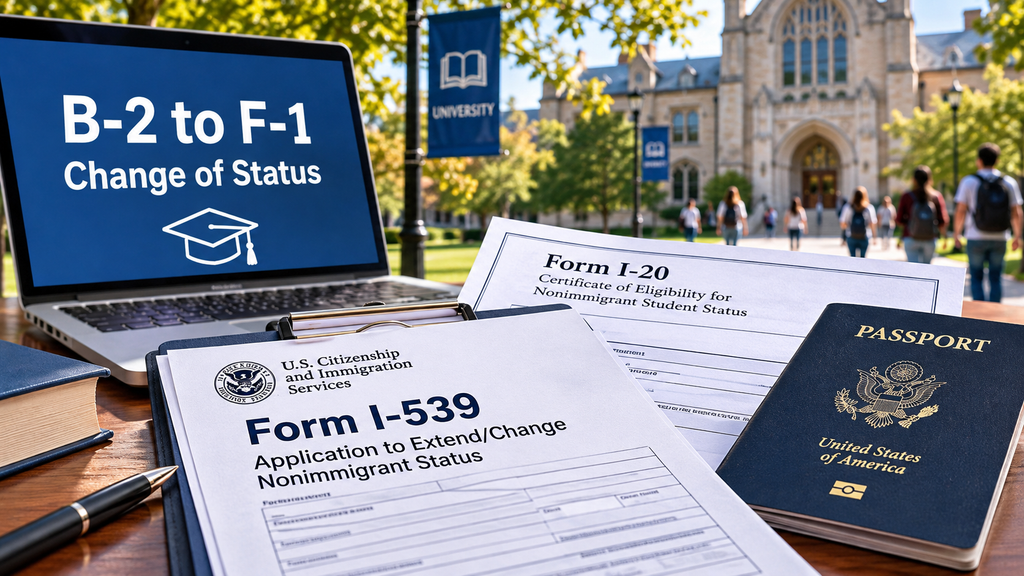
What Is a B-2 to F-1 Change of Status?
A B-2 to F-1 change of status allows certain visitors to request a different nonimmigrant classification while remaining in the United States.
For example, someone visiting relatives may decide to pursue a university degree after receiving an offer of admission.
Instead of returning abroad to apply for an F-1 visa, the visitor may request a change of status from USCIS.
However, approval changes the person’s immigration status inside the United States. It does not automatically provide an F-1 visa for future international travel.
USCIS handles these requests through Form I-539, Application to Extend/Change Nonimmigrant Status.
Who Qualifies for a B-2 to F-1 Change?
Applicants generally must satisfy several requirements.
First, they must have entered the United States lawfully and qualify for a change of nonimmigrant status.
Additionally, applicants generally must maintain their existing status and file before their authorized stay expires.
They must also demonstrate eligibility for F-1 classification, including admission to an appropriate academic institution and sufficient financial resources.
Maintaining Valid B-2 Status
The expiration date on Form I-94 generally determines how long a visitor may remain in the United States.
Importantly, this date differs from the expiration date printed on the visitor’s visa.
Therefore, applicants should check their I-94 before beginning the process.
USCIS may deny requests when applicants violate the conditions of their existing status or file after their authorized stay ends, although limited exceptions exist.
Demonstrating Genuine Student Intent
Applicants must establish that they genuinely intend to pursue an eligible academic program.
For example, USCIS may examine educational plans, financial arrangements, and the circumstances surrounding the decision to study.
Moreover, applicants must explain their change of plans accurately.
A visitor who misrepresented their intentions when seeking a visa or admission may face additional immigration consequences.
Can You Study While B-2 to F-1 Is Pending?
B-2 visitors generally cannot begin a full course of study before USCIS approves their change to F-1 status.
This restriction is particularly important because admission to a university does not independently authorize enrollment in an academic program.
Likewise, submitting Form I-539 does not immediately grant F-1 privileges.
For instance, a visitor who receives university admission in March should not assume they can start full-time classes in April while USCIS reviews the application.
Instead, the applicant must obtain the necessary approval before beginning studies.
The U.S. Department of State’s student visa guidance explains this restriction.
How to Apply for B-2 to F-1 Status
Applicants should coordinate their immigration filing with the prospective school’s international student office.
Step 1: Obtain Admission to a School
First, apply to a school that holds Student and Exchange Visitor Program (SEVP) certification.
After admission, the school’s Designated School Official (DSO) can prepare the documentation necessary for F-1 classification.
Importantly, applicants should confirm that their chosen academic program qualifies for F-1 status.
Step 2: Receive Form I-20
Next, obtain Form I-20, Certificate of Eligibility for Nonimmigrant Student Status.
The document identifies the student, educational institution, program details, and estimated financial requirements.
Additionally, the school creates the relevant Student and Exchange Visitor Information System (SEVIS) record.
Applicants should verify that their personal information and proposed program dates are accurate.
The Department of Homeland Security explains how designated school officials issue Form I-20 and maintain student records in SEVIS in its Form I-20 guidance.
Step 3: Pay the SEVIS Fee
Prospective F-1 students generally must pay the I-901 SEVIS fee.
The standard fee is $350, separate from the USCIS change-of-status application fee.
Therefore, applicants should budget for both payments.
Furthermore, retain the SEVIS payment confirmation because USCIS may require evidence of payment.
Step 4: Complete Form I-539
Applicants must complete Form I-539 and select the appropriate change-of-status classification.
They should provide accurate information about their immigration history, current admission, and requested student status.
Moreover, USCIS may require additional information about the circumstances leading to the change of plans.
Review the official Form I-539 instructions before filing.
Step 5: Prepare Supporting Documents
A typical application may include:
- A valid passport and current Form I-94.
- The school-issued Form I-20.
- Evidence of SEVIS fee payment.
- Bank statements or financial sponsorship documents.
- A university admission letter.
- An explanation of the decision to pursue studies.
- Evidence demonstrating compliance with B-2 status.
However, the exact documentation depends on the applicant’s circumstances.
Above all, supporting evidence should establish eligibility and provide a consistent explanation of the proposed change.
Step 6: File and Monitor the Application
Finally, submit Form I-539 through an eligible filing method and pay the correct fee.
Keep your USCIS receipt notice and monitor correspondence.
If USCIS requests additional evidence, respond within the stated deadline.
Meanwhile, coordinate with your DSO to ensure your school records remain accurate.
B-2 to F-1 Filing Deadline and Status Gaps
Applicants generally must file before their current authorized stay expires.
Nevertheless, a timely filing does not automatically mean USCIS has granted F-1 status.
If the original B-2 period expires while USCIS reviews the request, the applicant’s immigration position requires careful analysis. A properly filed, nonfrivolous application may protect against unlawful-presence accrual while pending, even though it does not automatically extend B-2 status.
Importantly, USCIS no longer generally requires separate extension applications merely to bridge the gap between the previous status expiration and the F-1 program start date.
This policy applies when applicants meet the relevant filing and eligibility requirements.
Therefore, applicants should avoid relying on outdated advice requiring repeated B-2 extension filings.
How Much Does a B-2 to F-1 Change Cost?
The published USCIS fee schedule lists the standard Form I-539 filing fees as:
- $420 for online filing.
- $470 for paper filing.
Additionally, prospective F-1 students generally pay the separate $350 SEVIS fee.
Some applicants may also incur school-related administrative expenses or legal fees.
Because USCIS periodically changes its fee requirements, check the current Form G-1055 Fee Schedule before submitting payment.
What Happens While USCIS Reviews Form I-539?
USCIS processing times depend on workload, application complexity, and other factors.
Consequently, applicants should not assume that USCIS will approve their change before their original school start date.
If the application remains pending, contact the DSO about deferring the program start date.
The school must maintain the appropriate SEVIS record while USCIS considers the request.
In addition, eligible applicants may request premium processing through Form I-907 for an additional fee.
However, premium processing does not guarantee approval.
What Happens After B-2 to F-1 Approval?
Once USCIS approves the change, the applicant receives F-1 status according to the approval notice.
The student must then follow the applicable F-1 requirements, including enrollment, school reporting, and restrictions on employment.
Furthermore, students should coordinate with their DSO before beginning their programs.
F-1 status does not automatically authorize unrestricted employment.
Later, eligible students may pursue practical training opportunities. Our F-1 OPT and STEM OPT guide explains those separate employment authorization procedures.
Can You Travel Abroad After Changing Status?
USCIS approval of Form I-539 changes immigration status within the United States, but it does not place an F-1 visa in the applicant’s passport.
Therefore, an individual who travels abroad generally needs an appropriate F-1 visa before seeking readmission, unless an exception applies.
Travel during a pending change-of-status application can also undermine the request.
Consequently, applicants should review their travel plans before leaving the United States.
What If USCIS Denies the B-2 to F-1 Request?
USCIS may deny the application because of status violations, insufficient evidence, ineligibility, or other legal concerns.
If USCIS denies the request after the previous authorized stay has expired, the applicant may face immediate immigration consequences.
However, the appropriate response depends on the circumstances and the reasons for denial.
Applicants should not confuse an unsuccessful change-of-status request with F-1 reinstatement, which addresses certain violations by individuals who previously held student status.
Our F-1 reinstatement guide explains that separate remedy.
Frequently Asked Questions About B-2 to F-1
Can I Change From B-2 to F-1 Without Leaving the United States?
Yes. Eligible visitors may file Form I-539 and request F-1 status through USCIS without leaving the country.
However, approval is not automatic.
Can I Start Classes Before USCIS Approves My Application?
Generally, no. B-2 visitors must wait for approval before beginning a full academic program.
Do I Need a New F-1 Visa After Approval?
Not while you remain in the United States solely because USCIS approved the change. However, international travel generally requires an appropriate visa for readmission.
What If My School Start Date Changes?
Contact your DSO promptly. The school may need to defer your program start date and update SEVIS while USCIS processes your application.
Conclusion
A B-2 to F-1 change of status offers eligible visitors a way to pursue academic studies without first leaving the United States.
However, success depends on lawful admission, eligibility, accurate documentation, and timely filing.
First, applicants should secure admission and obtain Form I-20. Next, they should prepare Form I-539 and the supporting evidence. Finally, they must wait for USCIS approval before beginning studies.
Careful coordination with the school can help prevent avoidable immigration complications.
Disclaimer: This page provides general information, not legal advice. Immigration rules and procedures change. Always rely on current instructions from USCIS and the U.S. Department of State (linked above) and consult a qualified attorney about your specific situation.
Leave a Reply