An H-4 EAD allows certain spouses of H-1B visa holders to work legally in the United States. However, not every H-4 dependent qualifies for employment authorization. Eligibility depends on the H-1B spouse’s immigration situation and compliance with USCIS requirements.
Furthermore, recent regulatory changes have affected how applicants renew their employment authorization documents. Therefore, spouses must understand the current rules before applying or continuing employment.
This guide explains H-4 EAD eligibility, Form I-765 filing procedures, USCIS fees, supporting documents, and the latest renewal requirements.
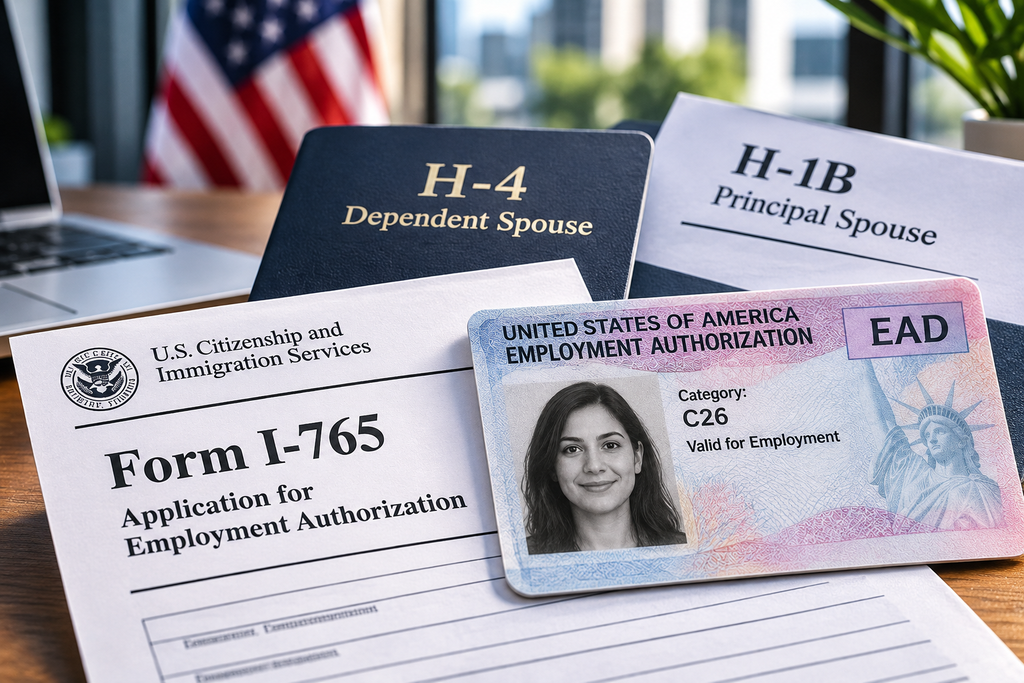
What Is an H-4 EAD?
An H-4 Employment Authorization Document (EAD) allows eligible spouses of H-1B workers to accept employment in the United States.
H-4 status alone does not authorize employment. Instead, qualifying spouses must request permission from U.S. Citizenship and Immigration Services (USCIS).
Once USCIS approves Form I-765 and grants employment authorization, the applicant may generally work for different employers without obtaining separate employer sponsorship.
Unlike the H-1B classification, an H-4 EAD does not restrict employment to a particular sponsoring company.
For official requirements, consult the USCIS H-4 employment authorization guidance.
Who Qualifies for an H-4 EAD?
Applicants must hold valid H-4 status as the spouse of an H-1B nonimmigrant.
Additionally, the principal H-1B worker must satisfy at least one of two eligibility conditions.
H-1B Spouse With an Approved Form I-140
First, an H-4 spouse may qualify if the principal H-1B worker is the beneficiary of an approved Form I-140, Immigrant Petition for Alien Workers.
Form I-140 plays an important role in employment-based immigration because it establishes eligibility for a particular immigrant classification.
However, the H-1B worker does not need to receive a green card before the qualifying H-4 spouse requests employment authorization.
Our Form I-140 guide explains how employment-based immigrant petitions work.
H-1B Spouse With an AC21 Extension
Alternatively, the H-4 spouse may qualify when the principal worker receives an H-1B extension under sections 106(a) and (b) of the American Competitiveness in the Twenty-first Century Act (AC21).
These provisions may allow qualifying H-1B workers to remain in the United States beyond the usual six-year limitation.
For example, an employer may have started an employment-based immigration process sufficiently early to support an AC21 extension.
However, an ordinary H-1B extension does not automatically satisfy this requirement.
Consequently, applicants must establish the specific statutory basis for the principal worker’s extension.
Can H-4 Children Apply for Work Authorization?
No. The H-4 EAD program generally applies to qualifying spouses, not dependent children.
Although unmarried children under 21 may obtain H-4 status through a qualifying parent, that status does not make them eligible for employment authorization under this program.
Therefore, H-4 families should distinguish dependent immigration status from employment eligibility.
How to Apply for an H-4 EAD
Applicants request employment authorization by submitting Form I-765 to USCIS.
Before filing, they should gather evidence concerning their own H-4 status and the principal spouse’s H-1B immigration history.
Step 1: Confirm H-4 Status
First, review your Form I-94 and USCIS approval notices.
These records should establish that you currently hold H-4 status.
Additionally, verify the expiration date of your authorized stay. Your employment authorization generally cannot extend beyond the relevant period of H-4 eligibility.
Step 2: Complete Form I-765
Next, obtain the current version of Form I-765, Application for Employment Authorization.
Select eligibility category (c)(26), which applies to qualifying H-4 dependent spouses.
Furthermore, provide accurate identifying information and disclose relevant immigration history.
The USCIS Form I-765 page provides filing instructions and current form requirements.
Step 3: Prepare Supporting Evidence
Applicants generally need documents establishing their relationship, immigration status, and eligibility for employment authorization.
Relevant evidence may include:
- A copy of the applicant’s Form I-94 showing H-4 status.
- A marriage certificate establishing the spousal relationship.
- The principal spouse’s H-1B approval notices.
- Evidence of an approved Form I-140.
- Documentation supporting a qualifying AC21 extension.
Moreover, applicants may need additional documents when their circumstances involve previous marriages or complex immigration histories.
USCIS may consider secondary evidence in appropriate cases. Nevertheless, complete documentation can help reduce avoidable processing delays.
Step 4: Submit the Application
Finally, submit Form I-765 using the filing method and address that USCIS currently requires for category (c)(26).
Applicants may also submit Form I-765 alongside certain Form I-539 requests involving H-4 status.
However, when an applicant needs USCIS to approve an H-4 change or extension, USCIS generally must resolve that status request before approving the related employment authorization.
Therefore, applicants should coordinate the timing of both filings carefully.
How Much Does an H-4 EAD Cost?
The standard USCIS Form I-765 filing fee is $520 for paper filing.
Although the general fee schedule also lists a lower online filing fee for eligible categories, online filing is not available for every Form I-765 classification. Applicants under category (c)(26) should follow the designated filing instructions rather than assume they can apply online.
Before filing, consult the current USCIS Form G-1055 Fee Schedule.
Additionally, applicants who need to extend H-4 status through Form I-539 may face a separate filing fee.
H-4 EAD Renewal Rules in 2026
Recent changes have made timely renewal particularly important.
Previously, certain H-4 spouses could receive automatic extensions of employment authorization when they filed qualifying renewal applications before their existing EADs expired.
However, the Department of Homeland Security changed those rules effective October 30, 2025.
On October 14, 2026, DHS finalized the regulatory change.
Under the current rule, applicants who submit covered EAD renewal requests on or after October 30, 2025, generally do not receive an automatic employment authorization extension merely because they filed on time.
Importantly, the rule preserves qualifying automatic extensions that arose from renewal filings before October 30, 2025.
The DHS final rule published on October 14, 2026 confirms these changes to automatic EAD extensions.
When Should You Renew an H-4 EAD?
USCIS generally recommends submitting eligible renewal applications up to 180 days before the existing EAD expires.
Therefore, applicants should review their expiration dates well in advance.
If USCIS does not approve the renewal before the existing authorization expires, the applicant may need to stop working temporarily.
A pending renewal application alone generally does not authorize continued employment under the new rules.
Consequently, spouses and employers should plan for possible processing delays.
Can You Work While Your H-4 EAD Is Pending?
Applicants generally cannot begin employment simply because USCIS received Form I-765.
Instead, first-time applicants must obtain the required employment authorization before starting work.
Similarly, renewal applicants must determine whether they retain valid employment authorization during processing.
For example, an H-4 spouse whose EAD expires while a renewal remains pending may lose the ability to continue working.
However, applicants with qualifying automatic extensions established under the earlier rules may have different rights.
Therefore, carefully review the filing date, EAD validity, and applicable regulations.
How Long Does H-4 EAD Processing Take?
Processing times vary according to USCIS workload, the applicant’s circumstances, and related immigration filings.
Furthermore, applicants who submit Form I-765 alongside Form I-539 may encounter additional timing considerations.
USCIS may request further evidence when the original submission does not establish eligibility.
As a result, applicants should provide complete documentation and monitor their case status.
Premium processing is not generally available for H-4 EAD applications under category (c)(26).
Applicants should not assume that premium processing of a related H-1B petition guarantees an immediate EAD decision.
Does an H-4 EAD Allow Any Type of Employment?
An approved H-4 EAD generally permits employment with different U.S. employers.
For example, eligible spouses may change employers without requiring a new employment-based immigration petition for each position.
Additionally, employment authorization may permit self-employment, provided the individual complies with applicable laws.
However, the applicant must maintain qualifying immigration status and valid employment authorization.
For background on the principal worker’s immigration requirements, consult our H-1B visa guide.
H-4 EAD and International Travel
An H-4 EAD does not replace an H-4 visa or independently authorize admission into the United States.
Therefore, spouses planning international travel must verify their passport, visa, and immigration documentation.
Additionally, applicants should distinguish USCIS employment authorization from the visa application process administered by the U.S. Department of State.
The State Department expanded online-presence screening for H-1B and H-4 visa applicants beginning December 15, 2025.
Applicants can review the Department of State’s H-1B and H-4 screening guidance.
Consequently, applicants should account for possible consular delays when arranging international travel.
Common H-4 EAD Application Mistakes
Several errors can delay approval or interrupt employment:
- Assuming every H-4 spouse automatically qualifies for work authorization.
- Submitting Form I-765 under the wrong eligibility category.
- Failing to establish an approved I-140 or qualifying AC21 extension.
- Providing incomplete evidence of the marital relationship.
- Filing renewal applications too close to expiration.
- Assuming a pending renewal automatically extends employment authorization.
Above all, applicants should verify their eligibility and filing requirements before submitting documents.
Frequently Asked Questions About H-4 EAD
Can I Work for Any Employer With an H-4 EAD?
Generally, yes. An approved H-4 EAD does not restrict employment to a particular sponsoring employer.
However, the authorization must remain valid.
Does an Approved I-140 Automatically Grant H-4 Work Authorization?
No. Although an approved I-140 may establish an eligibility basis, the H-4 spouse must still apply for and receive employment authorization from USCIS.
Can I Apply for an H-4 EAD Outside the United States?
Generally, applicants must hold qualifying H-4 nonimmigrant status in the United States when requesting employment authorization.
An H-4 visa alone does not provide a U.S. work permit.
Does H-4 EAD Approval Guarantee a Green Card?
No. Employment authorization and permanent residence involve separate immigration procedures.
Therefore, an approved EAD does not independently establish eligibility for lawful permanent residence.
Conclusion
The H-4 EAD program allows qualifying spouses of H-1B workers to pursue employment opportunities in the United States.
However, eligibility depends on the principal spouse’s immigration circumstances, including an approved Form I-140 or a qualifying AC21 extension.
Applicants should first confirm their eligibility, then prepare Form I-765 and supporting documents. Furthermore, they should pay particular attention to the revised EAD renewal rules.
Because automatic extensions generally no longer apply to covered renewal filings submitted on or after October 30, 2025, early preparation is particularly important.
Disclaimer: This page provides general information, not legal advice. Immigration rules and procedures change. Always rely on current instructions from USCIS and the U.S. Department of State (linked above) and consult a qualified attorney about your specific situation.
Leave a Reply