An I-290B appeal may provide a way to challenge certain unfavorable decisions issued by U.S. Citizenship and Immigration Services (USCIS). When USCIS denies an immigration petition or application, the affected party may have several options. Depending on the decision, these may include filing an administrative appeal, requesting reopening or reconsideration, or submitting a new application. However, each procedure has different legal requirements, deadlines, and potential consequences.
Understanding these differences is essential before challenging a USCIS decision.
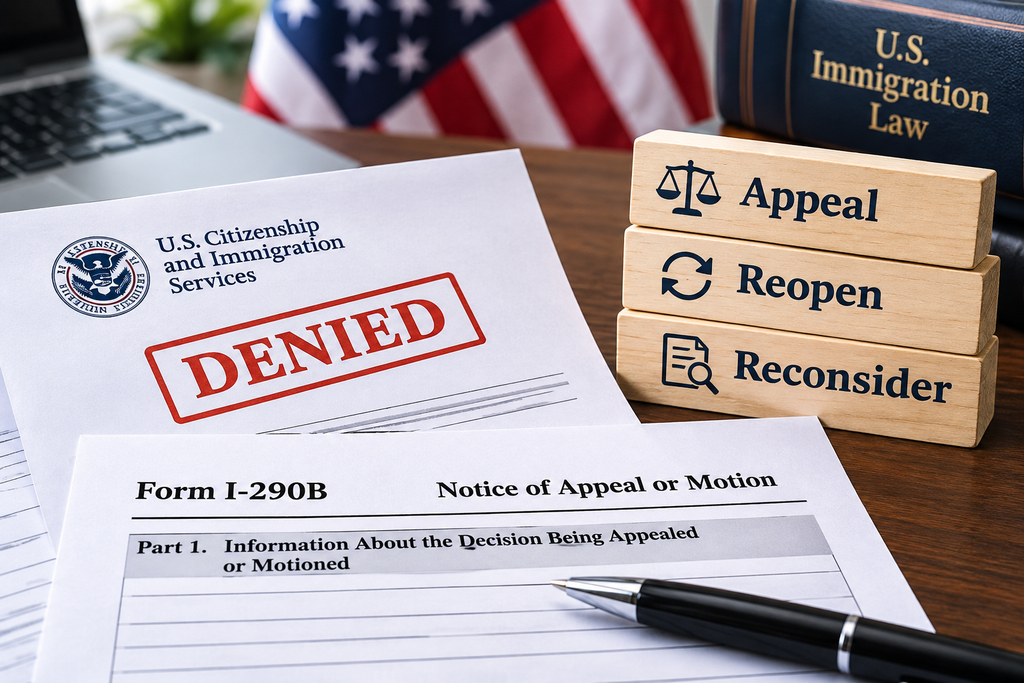
What Is an I-290B Appeal?
Form I-290B, Notice of Appeal or Motion, allows eligible parties to challenge certain USCIS decisions.
The form serves two principal purposes. First, it allows eligible parties to appeal decisions to the Administrative Appeals Office (AAO). Second, it allows parties to request that USCIS reopen or reconsider a previous decision.
An appeal and a motion do not serve identical purposes.
An appeal generally requests administrative review of an unfavorable decision. A motion, however, asks the office that issued the latest decision to examine the matter again.
USCIS explains these procedures in its official Form I-290B instructions.
Importantly, filing Form I-290B does not guarantee that USCIS will reverse its decision.
Who Can File an I-290B Appeal?
Not every immigration denial qualifies for review through Form I-290B.
The availability of an appeal depends on the particular immigration benefit, the governing regulations, and the type of decision involved.
For example, certain employment-based immigration petition denials may qualify for AAO review. Other decisions may permit only a motion or require an entirely different procedure.
Furthermore, only an affected party with legal standing generally has authority to file an appeal or motion.
In an employer-sponsored immigration case, the petitioning employer usually holds that right. The foreign worker normally cannot independently appeal the petition denial merely because the decision affects their immigration prospects. Limited statutory exceptions exist.
Before filing, review USCIS’s I-290B eligibility guidance and the instructions accompanying the actual denial notice.
Decisions That Require Different Procedures
Some immigration matters follow separate review systems.
For example, appeals involving certain Form I-130 family petitions fall under the jurisdiction of the Board of Immigration Appeals (BIA). These appeals generally use Form EOIR-29 rather than Form I-290B.
Likewise, naturalization denials generally involve a hearing request through Form N-336.
Therefore, applicants should never assume that every unfavorable USCIS decision qualifies for an I-290B appeal.
I-290B Appeal vs. Motion to Reopen vs. Motion to Reconsider
Choosing the appropriate procedure is one of the most important decisions after receiving a denial.
Although all three mechanisms can challenge an unfavorable decision, they address different problems.
Administrative Appeal
An administrative appeal generally argues that USCIS reached an incorrect conclusion about the facts or the applicable law.
For example, an employer may challenge a denial of an employment-based petition by arguing that USCIS incorrectly evaluated the evidence supporting the requested classification.
The appeal must identify specific factual or legal errors. Simply expressing disagreement with the outcome does not establish a valid basis for reversal.
Additionally, the appellant should address every independent ground of denial.
Motion to Reopen
A motion to reopen asks USCIS to review a decision based on new facts supported by documentary evidence.
The supporting evidence must demonstrate eligibility for the requested immigration benefit at the relevant time, including eligibility when the original application or petition was filed.
For example, a petitioner might present material documentation that clarifies an issue USCIS misunderstood during the original adjudication.
However, newly obtained documentation does not automatically establish a valid basis for reopening.
Motion to Reconsider
A motion to reconsider challenges the legal or policy analysis underlying the previous decision.
Unlike reopening, reconsideration generally focuses on the evidence already in the record when USCIS issued its decision.
The motion must explain how USCIS incorrectly applied immigration law or applicable policy. Relevant statutes, regulations, and precedent decisions may support the argument.
USCIS also permits eligible parties to combine motions to reopen and reconsider on one Form I-290B when they meet both sets of requirements.
I-290B Appeal Deadlines: How Much Time Do You Have?
Filing deadlines are among the most important considerations in any I-290B appeal.
Generally, USCIS requires eligible parties to file an appeal or motion within 30 calendar days of service of the unfavorable decision.
When USCIS serves the decision by mail, the applicable period generally increases to 33 calendar days.
However, an important exception applies to certain appeals involving revocation of an approved immigrant petition under 8 CFR 205.2. Those appeals generally have a 15-day deadline, or 18 days when USCIS serves the decision by mail.
The relevant service date is not necessarily the date the recipient actually opens or reads the notice.
Furthermore, weekends, federal holidays, and other filing rules may affect the calculation of the applicable deadline.
A late appeal ordinarily faces rejection. USCIS may excuse an untimely motion to reopen when the applicant demonstrates that the delay was reasonable and beyond their control. That discretionary exception does not generally extend to motions to reconsider.
Therefore, applicants should review their decision notices immediately and confirm the precise deadline before preparing a filing.
How to Prepare an I-290B Appeal
A persuasive appeal requires more than completing an immigration form.
The party challenging the decision must identify the legal problem, organize the supporting record, and explain why the unfavorable conclusion should not stand.
Step 1: Examine Every Ground of Denial
Begin by reviewing the entire USCIS decision.
Identify each factual finding, legal conclusion, and evidentiary deficiency.
Some decisions contain multiple independent grounds of denial. Successfully challenging only one may not resolve the remaining problems.
For example, an employment-based petition may face denial because USCIS questioned both the beneficiary’s qualifications and the petitioner’s supporting evidence.
A complete appeal should address each material issue.
Step 2: Determine the Correct Review Procedure
Next, establish whether the decision permits an AAO appeal, a motion, or another form of administrative review.
An appeal may be appropriate when the original decision contains identifiable errors. Reopening may offer a better procedural mechanism when material new facts justify renewed examination.
Meanwhile, reconsideration may be appropriate when the dispute concerns the application of law to the existing record.
The denial notice and applicable USCIS regulations should guide this assessment.
Step 3: Prepare the Supporting Arguments
A well-organized submission connects each challenged finding to the relevant law and evidence.
Depending on the procedure, supporting materials may include:
- A statement identifying the disputed findings.
- A legal brief explaining the grounds for review.
- Relevant immigration statutes and regulations.
- Applicable precedent decisions.
- Documentary evidence supporting a motion to reopen.
- References to evidence already included in the administrative record.
The submission should explain precisely why the original decision was incorrect or why reopening is justified.
Step 4: Complete and File Form I-290B
Complete the current edition of Form I-290B and select the appropriate appeal or motion category.
USCIS requires a statement identifying the basis for an appeal when filing the form, even if the appellant plans to submit a longer brief later.
For motions, the supporting brief and applicable documentary evidence generally must accompany the filing.
Additionally, verify the correct filing location, signature requirements, and applicable filing fee.
USCIS may change filing fees and procedures. Therefore, check its current form instructions before submitting the package.
What Evidence Strengthens an I-290B Appeal?
The appropriate evidence depends on the grounds of denial and the review procedure.
In an employment-based petition, the central dispute may involve the beneficiary’s qualifications, professional experience, proposed employment, or eligibility for the requested immigrant classification.
For example, an EB-2 National Interest Waiver case may involve disagreements about the proposed endeavor’s national importance or the petitioner’s ability to advance that endeavor.
Our EB-2 NIW guide explains the underlying eligibility framework.
However, evidence that might support a new petition does not necessarily justify reopening an existing decision.
A strong submission should identify the applicable legal standard and explain how the evidence satisfies it.
What Happens After Filing Form I-290B?
The next steps depend on whether the party filed an appeal or a motion.
For an eligible AAO appeal, the originating USCIS office generally conducts an initial review. It may take favorable action or forward the matter for appellate consideration.
The AAO can uphold the denial, withdraw an unfavorable decision, or return the case for further proceedings, depending on the circumstances.
For a motion, the adjudicating office reviews the arguments under the applicable reopening or reconsideration standard.
Importantly, a successful challenge does not always result in immediate approval of the underlying immigration benefit.
Sometimes USCIS must conduct additional adjudication before issuing a final decision.
Does an I-290B Appeal Protect Immigration Status?
Filing Form I-290B does not automatically grant lawful immigration status, employment authorization, or permission to remain in the United States.
This distinction matters particularly when a denial affects an applicant’s ability to work, maintain nonimmigrant status, or pursue adjustment of status.
Likewise, filing an appeal or motion should not be treated as an automatic suspension of every immigration-related consequence of the original decision.
Applicants should separately examine their status, authorized period of stay, employment authorization, and any applicable removal-related consequences.
These questions often require individualized legal advice.
Can You File Again Instead of Appealing?
In some circumstances, filing a new application or petition may be an alternative to pursuing an I-290B appeal.
However, refiling does not necessarily resolve the deficiencies identified in the original decision.
A new submission may require additional fees, updated documentation, and a fresh eligibility assessment.
Furthermore, filing again may affect priority-date considerations, immigration status, or other procedural rights.
Before selecting this option, compare the potential advantages and disadvantages of reopening, reconsideration, appeal, and refiling.
The correct choice depends on the underlying immigration benefit and the reason for denial.
I-290B Appeals Do Not Apply to Consular Visa Refusals
Form I-290B addresses eligible administrative decisions within the USCIS review framework.
It does not provide a general appeal mechanism for visa refusals issued by American embassies or consulates.
Consular visa adjudication falls under a separate legal framework administered by the U.S. Department of State.
For example, a refusal under INA section 221(g) may involve missing documentation or additional administrative processing.
The Department of State explains the applicable procedures in its official visa denials guidance.
Therefore, applicants should distinguish a USCIS petition denial from a consular visa refusal before choosing a procedural response.
When Should You Consult an Immigration Attorney?
Legal assistance may be particularly valuable when the denial involves complicated eligibility questions, competing interpretations of immigration regulations, or significant consequences for lawful status.
An attorney can evaluate whether an appeal or motion has a viable legal foundation.
Professional review may also help identify procedural mistakes, missing evidence, and arguments that could undermine the challenge.
For applicants who previously received a Request for Evidence, our USCIS RFE response guide explains how evidentiary deficiencies can arise before a final denial.
The most effective strategy generally begins with the original decision and the complete administrative record.
Conclusion
An I-290B appeal can provide an important opportunity to challenge certain unfavorable USCIS decisions. However, appeals, motions to reopen, and motions to reconsider serve different legal purposes.
A successful challenge requires careful review of the denial, an appropriate procedural basis, timely filing, and arguments supported by the applicable law and evidence.
Furthermore, applicants must consider how the denial affects their immigration status and whether other procedural options remain available.
Understanding these distinctions helps applicants avoid filing mistakes and make informed decisions about the next stage of their immigration case.
Disclaimer: This page provides general information, not legal advice. Immigration rules and procedures change. Always rely on current instructions from USCIS and the U.S. Department of State (linked above) and consult a qualified attorney about your specific situation.
Leave a Reply