A USCIS (U.S. Citizenship and Immigration Services) green card interview can feel intimidating. However, most interviews follow a predictable structure. A green card interview lawyer usually prepares the case the same way: control the documents, keep the facts consistent, and practice clear answers. When you do that, you reduce stress and avoidable delays.
This guide focuses on the interview stage for adjustment of status. If you need the full filing roadmap, start with our Adjustment of Status Lawyer: I-485 Steps guide.
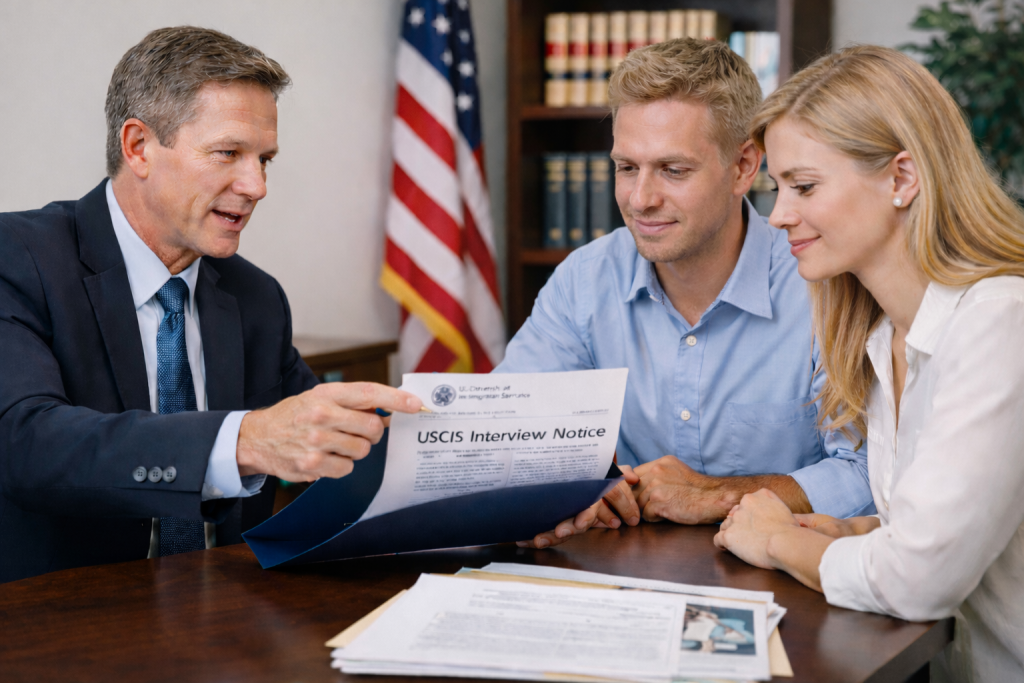
When USCIS schedules the green card interview
USCIS does the following tasks related to the green card interview:
1. It uses the interview to confirm eligibility, verify identity, and resolve questions the officer cannot answer from the paper file alone. In many cases, the officer also checks whether your documents match what you filed earlier.
2. It describes the adjustment process and notes that an interview may be required in its adjustment of status overview.
3. USCIS also explains interview standards and how officers approach interviews in the Policy Manual’s interview guidelines for adjustment cases.
What a green card interview lawyer does before the interview
A green card interview lawyer usually focuses on control and consistency. That sounds simple, yet it prevents many interview problems.
Here is the core preparation approach:
Rebuild the case narrative from the forms you already filed, since the officer will rely on them. Aim for answers that match what is on the paperwork.
Identify changes since filing, such as a new job, new address, new child, or new travel. Prepare a clear way to explain each update and document it.
Organize your documents so the interview feels like a clean review, not a scramble. Labeled sections help you find key items quickly.
Practice the high-risk questions without memorizing a script. Focus on calm, accurate answers.
What to bring to the USCIS interview
Your interview notice controls. Always follow the notice instructions first. Still, most adjustment interviews require the same document categories.
- Start with your appointment notice and a set of identity documents.
2. Have a government-issued photo ID ready.
3. Include your current passport and any older passports you used for U.S. travel, if you still have them.
4. Gather copies of key immigration documents you already hold, such as your I-94, EAD, or Advance Parole, if they apply.
5. Print a complete copy of the I-485 packet you filed, including forms, exhibits, and supporting evidence. Many people forget this step, and it makes the interview harder than it needs to be.
6. Bring originals of civil documents you submitted as copies. Officers often want to see originals, even when you already provided photocopies.
7. Common examples include birth certificates, marriage certificates, divorce decrees, and any legal name-change documents.
8. Bring updated evidence since filing.
9. Recent pay statements and, if possible, an employment verification letter help document any job change since filing.
10. Proof of your current residence matters if you moved after you filed.
11. Updated relationship evidence is important in cases based on a family relationship, especially when time has passed since filing.
A green card interview lawyer often builds this as a simple “then vs. now” packet: what you filed, plus what changed.
How the USCIS officer usually runs the interview
Most interviews follow a consistent flow:
The officer confirms your identity and places you under oath.
Then the officer reviews your I-485 and asks you to confirm basic facts. Expect questions about your name, date of birth, address history, and immigration history.
After that, the officer often runs through the “yes/no” eligibility and admissibility questions on the form. These can feel repetitive. Still, they matter. Answer carefully and do not guess.
If your case relies on a petition, the officer may also review that petition’s facts. In marriage cases, the officer often compares I-130 facts with I-485 answers.
At the end, the officer may ask for missing items, explain next steps, or tell you the case needs additional review. Either outcome can be normal.
Green card interview lawyer checklist for consistency traps
Many interview problems come from inconsistencies, not from eligibility.
A green card interview lawyer usually checks these areas because they create avoidable friction:
Address history and dates. Small gaps can trigger follow-up questions.
Employment history and job titles. People often describe the same job in two different ways.
Prior immigration filings. Even old applications can matter if the facts conflict.
Prior marriages and family facts. Officers often verify dates and legal documents.
Arrests, citations, or court issues. If anything exists, bring certified dispositions when possible and be ready to explain the outcome clearly.
If you do not know an answer, say so. Then offer to confirm it. A confident wrong guess can harm credibility.
If your green card is through marriage
Marriage-based cases can include extra relationship questions. The officer wants to confirm you have a real, ongoing marriage, not a paper marriage.
You do not need to bring your entire I-130 evidence file again. Instead, bring updated proof since filing that shows shared life.
Useful examples include updated joint lease or mortgage documents, joint bank statements, joint insurance, shared bills, and photos from normal life events. Keep it organized and recent.
If you want the full marriage-based roadmap, including how the I-130, I-485, and I-864 fit together, use our marriage-based guide.
A green card interview lawyer can also help you plan for sensitive topics. For example, couples sometimes have long-distance periods, complex family situations, or prior marriages. You can address those facts directly when you prepare.
Rescheduling, moving, or updating information before the interview
Life changes while a case is pending. The key is to keep USCIS informed and to keep your file consistent.
If you move, update your address promptly through USCIS’s official address change process.
Also bring proof of the new address to the interview. That way you can show the officer the change is real and documented.
If you need to reschedule, follow the instructions on your interview notice. Do not ignore the notice. Missing an interview can create serious delays and, in some cases, lead to a denial for abandonment.
If you have major changes since filing, such as a new job, a new child, or a new legal issue, plan how you will document it and explain it clearly.
What happens after the interview
Some cases are approved quickly. Others move into further review.
Common outcomes include:
1. Approval. You may receive an approval notice soon after, or you may see the status update later.
2. Request for Evidence (RFE). USCIS may ask for a missing document or an updated item.
3. Further review. The officer may say the case needs supervisory review or additional checks. That does not automatically mean a denial.
In all cases, keep copies of what you brought and what you handed to USCIS. Keep your tracking organized. A green card interview lawyer often helps clients build a clean record in case USCIS later asks follow-up questions.
When to hire a green card interview lawyer for interview preparation
Many people attend interviews without a lawyer and do fine. Still, interview preparation becomes more valuable when risk increases.
Consider legal help when:
- You have prior status violations, removal issues, or past denials.
2. You have any criminal history, even if the charges were dismissed.
3. Your case depends on complex facts, such as multiple prior filings or complicated relationship timelines.
4. You received an RFE or you expect the officer to focus on inconsistencies.
5. You feel unsure about how to explain changes since filing.
A green card interview lawyer does not “control” the officer. However, good preparation can reduce mistakes and help you answer with confidence.
If your case is consular processing instead of adjustment of status
This article focuses on USCIS interviews inside the United States. If you will interview at a U.S. embassy or consulate abroad, the process differs. The U.S. Department of State explains immigrant visa interview preparation and the documents you should bring in its interview preparation step.
Even then, the same principle applies. Keep facts consistent across forms, civil documents, and prior filings.
Conclusion
A USCIS adjustment interview becomes far less stressful when you prepare in a structured way. Start by reviewing what you filed. Next, gather originals and updated evidence. Then, practice clear answers that match your forms.
A green card interview lawyer adds the most value when your case has complexity or risk. Even in simple cases, disciplined preparation helps you avoid delays caused by missing documents, unclear timelines, or inconsistent answers.
Disclaimer: This page provides general information, not legal advice. Immigration rules and procedures change. Always rely on current instructions from USCIS and the U.S. Department of State (linked above) and consult a qualified attorney about your specific situation.
Leave a Reply