Form I-824 allows petitioners to request additional action on an approved immigration petition, including transferring it from U.S. Citizenship and Immigration Services (USCIS) to the National Visa Center (NVC).
This procedure may be necessary when USCIS approves a family-based or employment-based immigrant petition but retains it for adjustment of status rather than forwarding it for consular processing.
However, not every approved petition requires this form. Understanding when to file can help avoid unnecessary expenses and delays.
This guide explains Form I-824 eligibility, filing requirements, government fees, processing times, and what happens after the NVC receives an approved petition.
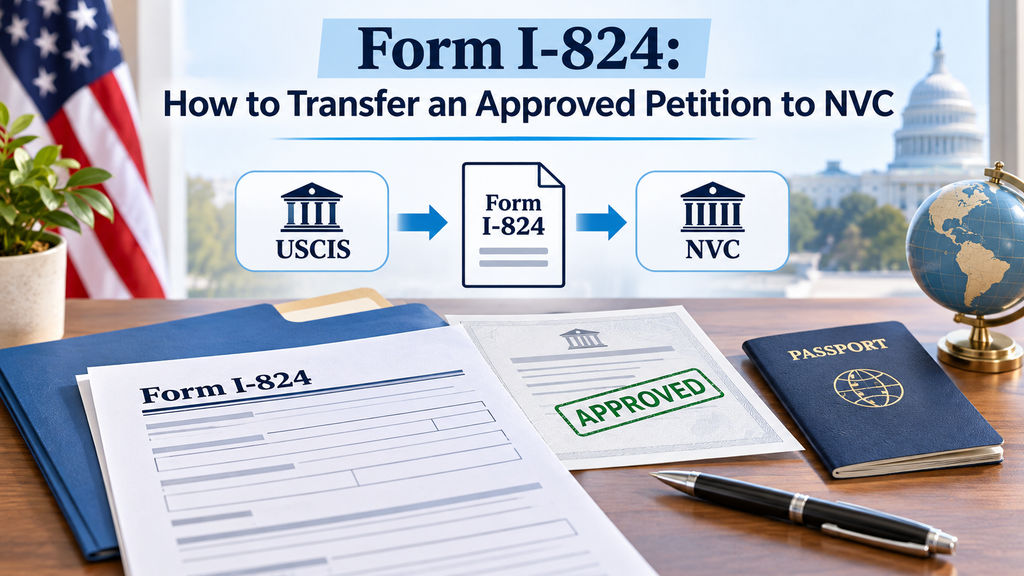
What Is Form I-824?
Form I-824, officially titled Application for Action on an Approved Application or Petition, requests additional government action on a previously approved immigration application or petition.
According to the USCIS Form I-824 instructions, the form can serve several purposes, including obtaining a duplicate approval notice, requesting certain consular notifications, and transferring an approved immigrant petition to the NVC.
For immigrant visa applicants, its most important function is often transferring a petition that USCIS retained for adjustment of status.
Form I-824 does not grant permanent residence or approve an immigrant visa. Instead, it allows the immigration process to proceed through the appropriate government agency.
When Is Form I-824 Required for NVC Processing?
Form I-824 may be necessary when USCIS approves an immigrant petition but does not forward it to the Department of State because the beneficiary originally intended to adjust status inside the United States.
Approved I-130 Petitions
Consider a U.S. citizen who files Form I-130 for a spouse intending to adjust status within the United States.
USCIS approves the petition and retains it for adjustment processing. However, the spouse later decides to obtain an immigrant visa through a U.S. consulate abroad.
In this situation, the petitioner may need to file Form I-824 requesting transfer of the approved petition to the NVC.
The first step is to examine the Form I-797 approval notice. It should indicate whether USCIS retained the petition or forwarded it for consular processing.
Applicants can also consult the official USCIS Form I-130 guidance for information about petition processing and subsequent procedures.
Approved I-140 Petitions
Form I-824 may also apply to approved employment-based immigrant petitions, including Form I-140.
For example, an employment-based beneficiary initially planning adjustment of status may subsequently pursue an immigrant visa abroad.
If USCIS retained the approved petition, an eligible petitioner may request its transfer to the NVC.
The appropriate procedure depends on the underlying petition and the specific action requested.
When Is Form I-824 Unnecessary?
Before filing, determine whether USCIS actually needs to take additional action.
If the petition is still pending, Form I-824 generally cannot accomplish a transfer because the requested action depends on an approval. Although limited concurrent filing circumstances exist, USCIS does not process the post-approval request before the underlying approval.
If USCIS already forwarded the petition to the NVC, filing the form is generally unnecessary. A delay in receiving the NVC Welcome Letter does not automatically mean the transfer failed.
Instead, review the Department of State’s NVC processing timeframes.
If the NVC already has the case, requests to change the consular interview location generally follow Department of State procedures rather than an additional USCIS transfer request.
Likewise, Form I-824 cannot revive a petition that has been denied or revoked.
How to File Form I-824
Filing Form I-824 requires accurate information about the approved petition, the relevant parties, and the requested action.
Step 1: Identify the Appropriate Filer
For a request to send an approved immigrant visa petition to the NVC, the original petitioner must generally submit Form I-824.
For example, when a U.S. citizen files Form I-130 for a foreign spouse, the U.S. citizen petitioner ordinarily files the subsequent transfer request.
Other Form I-824 purposes may involve different eligible applicants.
Step 2: Obtain the Current Form
Download Form I-824 from the official USCIS website.
Verify the accepted edition date and carefully complete all applicable sections. An outdated form or missing signature may result in rejection.
Step 3: Select the Correct Action
In Part 2, Item 1.d of the April 1, 2024 edition, applicants can request that USCIS send an approved immigrant visa petition to the NVC.
This selection is appropriate when the objective is transferring an eligible approved petition for consular processing.
Other selections concern different actions, such as duplicate approval notices or consular notifications. Therefore, choosing the correct option is essential.
Step 4: Prepare Supporting Documentation
The filing package generally includes:
- A completed and properly signed Form I-824.
- Information identifying the previously approved petition.
- A copy of the Form I-797 approval notice or other required proof of approval.
- The applicable government filing fee or evidence of an exemption.
- Any additional documentation required by the current form instructions.
Applicants should verify receipt numbers, filing dates, approval dates, and beneficiary information against the original USCIS records.
Step 5: Submit the Application to USCIS
USCIS changed Form I-824 filing locations effective October 7, 2026.
The agency announced a transitional period accepting certain filings sent to previous locations if postmarked by November 9, 2026.
Applicants should consult the official Form I-824 direct filing addresses before mailing their applications.
The correct location can depend on the filing category and responsible agency. Do not rely on addresses from older articles or previous filings.
How Much Does Form I-824 Cost?
As of November 2026, the standard USCIS filing fee for Form I-824 is $590.
Certain categories qualify for exemptions, including specified VAWA-related applications, Special Immigrant Juvenile cases, T and U nonimmigrant categories, and other designated classifications.
However, most ordinary requests to transfer an approved immigrant petition to the NVC require the standard fee.
Before submission, check the USCIS Form G-1055 Fee Schedule to confirm the applicable amount and payment requirements.
The I-824 fee is separate from any fees required later during immigrant visa processing.
How Long Does Form I-824 Take?
There is no universal processing period for Form I-824. USCIS processing times vary depending on workload, request type, and the office handling the application.
The overall transfer process involves several stages.
First, USCIS receives the application and issues a receipt notice. It then reviews the request and takes the appropriate action on the previously approved petition.
After the transfer, the NVC must receive the petition information and create or update the immigrant visa case.
Consequently, receiving an I-824 approval does not mean that the beneficiary can immediately schedule a consular interview.
Applicants should monitor their USCIS case status and, once the case reaches the NVC, consult the Department of State’s processing information.
What Happens After Form I-824 Approval?
Once the National Visa Center receives the approved immigrant petition, it generally creates a case and assigns an NVC case number.
When the case is ready for further processing, the NVC sends a Welcome Letter with instructions for accessing the Consular Electronic Application Center (CEAC).
Depending on the visa category, applicants may need to pay immigrant visa fees, complete Form DS-260, provide civil documents, and submit financial sponsorship evidence.
The NVC then reviews the required documentation before the case can proceed toward interview scheduling.
For more information about these requirements, see our NVC guide to CEAC fees and documentarily qualified status.
Interview scheduling depends on consular capacity, document completion, and visa availability where applicable.
Additionally, petition approval does not guarantee immigrant visa issuance. A consular officer must still determine whether the applicant meets the relevant legal requirements.
Our consular processing guide explains the broader immigrant visa procedure and potential complications.
Common Form I-824 Filing Mistakes
Filing Without Confirming the Petition’s Location
One common mistake is assuming that Form I-824 is necessary simply because the NVC has not contacted the beneficiary.
Always review the USCIS approval notice and applicable NVC timeframes before submitting another application.
Selecting the Wrong Requested Action
Form I-824 serves several purposes. Selecting the duplicate approval notice option instead of the petition-transfer option may prevent the application from achieving its intended result.
Providing Incorrect Information
Inconsistent receipt numbers, approval dates, or beneficiary information can complicate processing.
Carefully compare the application with the original USCIS notices.
Using an Outdated Filing Address
Because USCIS changed the filing arrangements in October 2026, relying on outdated instructions may result in rejected applications or unnecessary delays.
Verify the official filing address immediately before mailing.
Frequently Asked Questions
Can I file Form I-824 before my I-130 is approved?
Form I-824 generally requests action on an approved petition. USCIS will not process the requested post-approval action while the underlying petition remains pending.
If the intended processing method changes during the I-130 adjudication, the petitioner should consider contacting USCIS to update the case information.
Can the beneficiary file Form I-824?
For transferring an approved immigrant visa petition to the NVC, the original petitioner generally files the request.
Different eligibility rules may apply to other purposes of Form I-824.
Do I need a new I-130 if USCIS retained the approved petition?
Not necessarily. Form I-824 may allow an existing approved petition to proceed to consular processing without filing a new I-130.
The appropriate procedure depends on the petition’s status and individual circumstances.
Does Form I-824 speed up immigration processing?
No. Form I-824 does not automatically expedite USCIS or NVC processing.
Instead, it provides a mechanism for requesting necessary administrative action on an existing approval. In some cases, filing it is essential to move the petition forward, but it introduces an additional processing stage.
Conclusion
Form I-824 can be essential when USCIS approves an immigrant petition but retains it instead of transferring it to the National Visa Center.
Before filing, petitioners should determine whether USCIS still holds the approved petition or has already forwarded it to the Department of State.
If a transfer request is necessary, careful preparation, accurate supporting information, payment of the correct fee, and compliance with current filing instructions can reduce avoidable complications.
Ultimately, Form I-824 helps connect an existing USCIS approval with the next stage of consular processing. Understanding when and how to use it can prevent unnecessary filings and delays.
Disclaimer: This page provides general information, not legal advice. Immigration rules and procedures change. Always rely on current instructions from USCIS and the U.S. Department of State (linked above) and consult a qualified attorney about your specific situation.
Leave a Reply