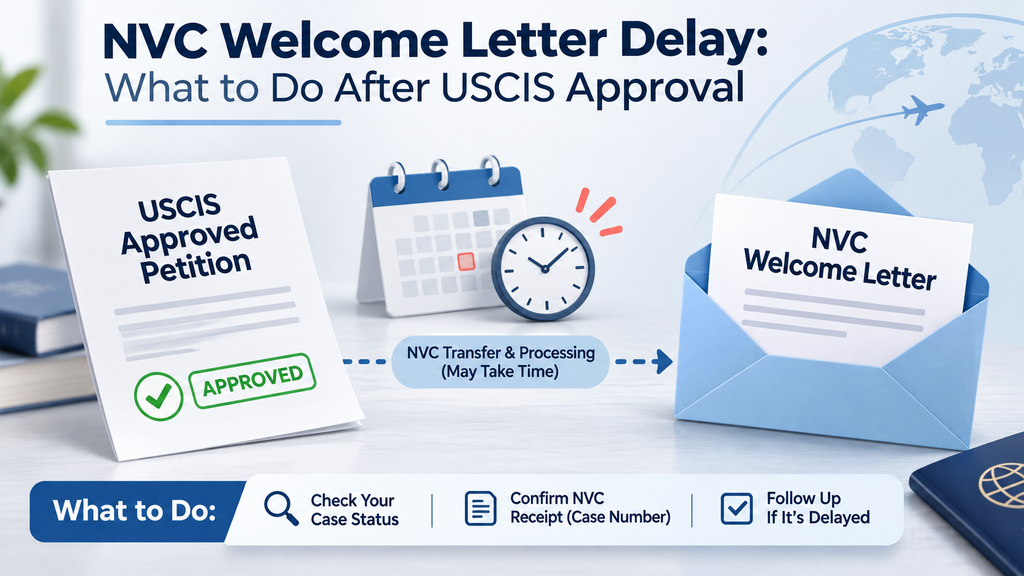
An NVC Welcome Letter tells immigrant visa applicants that the National Visa Center (NVC) has created their case after receiving an approved petition from U.S. Citizenship and Immigration Services (USCIS). It provides the information needed to access the next stage of consular processing.
However, receiving a USCIS approval notice does not mean the Welcome Letter will arrive immediately. The petition must reach the NVC, and the NVC must create the case. If you are still waiting, the correct response depends on where the delay occurred.
This guide explains why an NVC Welcome Letter may be delayed, how to check your case, and when to contact the appropriate agency.
What Is the NVC Welcome Letter?
The NVC Welcome Letter normally provides an immigrant visa case number and an invoice ID. These allow eligible applicants to access the Consular Electronic Application Center (CEAC) and follow the Department of State’s instructions.
Once the case is ready for processing, CEAC may be used to pay applicable fees, complete Form DS-260, submit required documents, and read messages from the NVC.
The Welcome Letter does not constitute an immigrant visa approval or an interview appointment. It marks the beginning of NVC processing, not the end of the immigration process.
The Department of State’s explanation of NVC processing describes these stages.
Why Has the NVC Welcome Letter Not Arrived?
Several different issues can produce the same apparent delay.
USCIS Has Not Yet Transferred the Petition
After approving a petition intended for consular processing, USCIS must forward it to the Department of State. This transfer is separate from the approval itself.
Some transfers are electronic, while others involve paper records. The Department of State notes that mailed petitions may take an additional two to three weeks to reach the NVC.
Therefore, counting only from the I-797 approval date can give a misleading impression of how long the NVC has been handling the case.
The NVC Has Not Yet Created the Case
Receiving a petition and creating its case record are separate steps. The NVC must enter the petition information, assign the case identifiers, and send instructions.
Its workload changes over time. Instead of relying on a fixed estimate from an old article, consult the official NVC timeframes.
Importantly, the case creation date refers to petitions received from USCIS, not simply petitions approved by USCIS.
USCIS Retained the Approved Petition
USCIS sometimes retains a petition because the beneficiary was expected to apply for adjustment of status in the United States.
If the beneficiary later needs an immigrant visa through an embassy abroad, the original petitioner may need to request additional action. In appropriate cases, Form I-824 is used to ask USCIS to forward the approved immigrant petition to the NVC.
Do not assume this form is necessary merely because no letter has arrived. First determine what the approval notice says about the petition’s destination.
The Notification Was Missed
The NVC may send the Welcome Letter by email or physical mail. An outdated address, incorrect contact information, spam filtering, or correspondence sent to an attorney can cause confusion.
Check the petitioner’s and beneficiary’s email accounts, including spam folders, and ask any authorized representative whether they received a notification.
How to Check an NVC Welcome Letter Delay
A short sequence of checks can often identify the appropriate next step.
Step 1: Read the USCIS Approval Notice
Review Form I-797 and note the original receipt number, petition type, approval date, and beneficiary’s details.
Look for language stating whether USCIS forwarded the approved petition to the Department of State or retained it.
If the notice indicates retention, the issue may require USCIS action rather than an inquiry about NVC case creation.
Step 2: Compare the Correct NVC Processing Timeframe
On the NVC timeframes page, find the case creation timeframe, not the case review timeframe.
Case creation concerns petitions received from USCIS. Case review concerns supporting documents submitted later through the immigrant visa process. Public inquiry response times are a third, separate category.
Compare the reported case creation date with the best available information about when your petition reached the NVC. The approval date alone does not establish the transfer date.
If your case is still within the normal timeframe, additional inquiries may not help.
Step 3: Check All Correspondence
Look for messages sent to the petitioner, beneficiary, or attorney. Confirm that the email and mailing addresses in the case records are accurate.
Do not confuse the USCIS receipt number with the NVC case number. USCIS assigns the first number during petition processing; the NVC assigns the second after case creation.
Step 4: Submit an NVC Inquiry When Appropriate
If the relevant timeframe has passed and the case should have arrived, use the NVC Public Inquiry Form.
The form accepts an NVC case number or USCIS receipt number. This means you can inquire even if you have not yet received your NVC case number.
Include identifying information and a concise explanation: the petition type, USCIS approval date, receipt number, and whether the approval notice mentions forwarding to the Department of State.
Submit one clear inquiry and allow the published response time. Repeated inquiries about the same issue do not speed up processing.
What if USCIS Never Sent the Petition to the NVC?
A missing Welcome Letter is not always an NVC problem.
If USCIS retained the approved petition for adjustment of status, the petitioner may need to request its transfer for consular processing. Form I-824, Application for Action on an Approved Application or Petition, can serve that purpose in eligible cases.
However, the procedure depends on the underlying petition and why it was retained. Review the USCIS Form I-824 instructions and the specific approval notice before filing.
Avoid submitting Form I-824 automatically. It involves a separate filing process and usually a fee, and it will not accelerate an NVC case that already exists.
Likewise, a delayed Welcome Letter does not ordinarily mean that you must start over with a new Form I-130 or I-140.
Does Visa Availability Affect the Welcome Letter?
Immediate-relative immigrant visas for qualifying relatives of U.S. citizens are not subject to annual numerical limits. Family-preference and employment-preference cases, however, may depend on visa availability and the applicant’s priority date.
For some preference cases, the NVC may have the approved petition but delay instructions to begin full pre-processing until a visa is available or expected to become available.
Consequently, distinguish between not receiving a case number and having a case that is not yet ready for fee payments or document submission. The two situations require different responses.
What Happens After the Welcome Letter Arrives?
Keep the Welcome Letter in a safe place. The case number and invoice ID are needed for access to CEAC throughout the immigrant visa process.
When instructed, applicants may need to pay fees, complete Form DS-260, provide civil documents, and submit Form I-864 with supporting financial information where required. After submission, the NVC reviews documents and may request corrections.
Our NVC guide to CEAC fees and documentarily qualified status covers this next stage in detail.
Documentarily complete status is not the same as an interview appointment. Scheduling also depends on consular availability and, for numerically limited categories, visa availability.
Our consular processing guide explains the broader steps leading to an immigrant visa interview.
Common Mistakes to Avoid
Several mistakes can make an already delayed case more complicated:
- Filing Form I-824 before verifying whether USCIS actually retained the approved petition.
- Treating NVC case review time as the timeframe for creating a new case.
- Assuming the USCIS approval date is the day the NVC received the petition.
- Sending repeated inquiries while the case remains within published timeframes.
- Filing a new immigrant petition without first confirming the status of the existing approval.
Checking the available records before taking further action can prevent unnecessary filings and expenses.
Frequently Asked Questions
How long does an NVC Welcome Letter take after USCIS approval?
There is no guaranteed period. Transfer time and NVC case creation both matter. Check the State Department’s current case creation timeframe rather than relying on a universal estimate.
Can I contact NVC without an NVC case number?
Yes. The public inquiry form accepts a USCIS receipt number if you have not yet received your NVC case number.
Can I complete DS-260 before receiving the Welcome Letter?
Normally, applicants need the NVC case number, invoice ID, and the relevant instructions before accessing their case and completing the applicable CEAC steps.
Does a delayed Welcome Letter mean USCIS denied my petition?
No. A delay alone does not cancel a previously approved petition. Check the case’s transfer status and any subsequent official notices before drawing conclusions.
Conclusion
An NVC Welcome Letter delay can arise during USCIS transfer, NVC case creation, or delivery of the notification. Start with the approval notice, then check the published NVC timeframes and your correspondence.
If the case should have reached the NVC, submit a focused inquiry. If USCIS retained the petition, determine whether a separate transfer request is needed. Identifying the correct stage prevents unnecessary filings and helps you take the next useful action.
Disclaimer: This page provides general information, not legal advice. Immigration rules and procedures change. Always rely on current instructions from USCIS and the U.S. Department of State (linked above) and consult a qualified attorney about your specific situation.
Leave a Reply