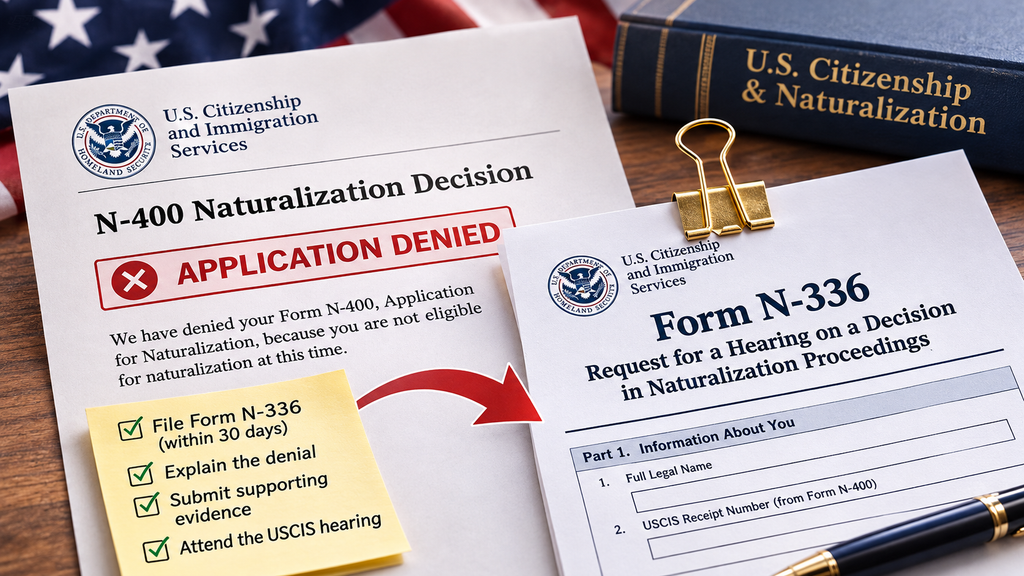
Form N-336 allows applicants to challenge USCIS decisions that deny their Form N-400 applications for naturalization.
Instead of submitting a new citizenship application, eligible applicants can request a hearing before a different USCIS officer.
A naturalization denial does not necessarily prevent an applicant from obtaining U.S. citizenship. However, applicants must meet strict filing deadlines and explain why USCIS should reconsider its decision. Therefore, understanding the hearing procedure is essential before filing.
What Is Form N-336?
Specifically, applicants can use Form N-336, officially titled Request for a Hearing on a Decision in Naturalization Proceedings Under Section 336, to request administrative review of an N-400 denial.
Furthermore, a reviewing officer examines the disputed decision and may consider additional evidence. Unlike a new naturalization application, this procedure focuses on an existing denial.
However, Form N-336 does not apply to every unfavorable immigration decision. In contrast, other immigration applications may require different appeals or motions.
Applicants can obtain the latest form and instructions from the USCIS Form N-336 page.
Form N-336 Filing Deadline
Applicants generally must request a hearing within 30 calendar days of service of the N-400 denial. However, applicable service rules may provide additional time when USCIS mails the decision.
The regulation at 8 CFR § 336.2 governs this procedure.
First, review the denial notice immediately. Then, identify the applicable filing deadline and keep proof that you submitted your request on time.
USCIS generally rejects untimely hearing requests. Nevertheless, the agency may treat certain late submissions as motions to reopen or reconsider when they satisfy the relevant requirements.
Therefore, applicants should not rely on this limited exception.
Why Does USCIS Deny Naturalization?
The correct Form N-336 argument depends on the reason USCIS denied Form N-400.
Continuous Residence and Physical Presence
Most applicants must satisfy continuous residence and physical presence requirements.
For example, extended international travel may disrupt an applicant’s continuous residence in the United States. Separately, an applicant may fail to accumulate enough days physically present in the United States.
If USCIS makes errors when calculating travel periods, applicants can submit passports, travel records, and other supporting documents to correct them.
Good Moral Character
USCIS reviews conduct relevant to the statutory good moral character requirement. Certain criminal offenses, false testimony, and other circumstances can affect eligibility.
A hearing request should address the specific legal ground cited in the denial, not simply assert that the applicant has behaved responsibly.
English or Civics Test Failure
Applicants ordinarily receive a second opportunity to pass a failed naturalization test component during the N-400 process. USCIS may deny an application after another failure.
At an N-336 hearing, USCIS generally administers the portion of the English or civics test the applicant previously failed, with one opportunity to pass that portion.
Insufficient or Inconsistent Evidence
USCIS may deny naturalization when the record does not establish eligibility or contains unresolved discrepancies. Applicants can challenge factual findings or submit documents that clarify the relevant issue.
A denial differs from a pending request for additional evidence. See our USCIS Request for Evidence guide for that earlier stage.
How to File Form N-336
Step 1: Analyze the Denial Notice
Read the full decision. List each reason for denial, the facts USCIS relied on, and any cited statute or regulation.
Separate factual disputes from legal disagreements. For example, a travel-date error requires different evidence than a dispute over the legal effect of a criminal conviction.
Step 2: Complete the Current Form
Download the latest version from USCIS. Enter the applicant’s identifying details and the information about the denied N-400 accurately.
Check whether USCIS permits online filing for your circumstances. Follow the current instructions and sign the request correctly.
Step 3: Explain the Error
State why USCIS should change the decision. Identify the disputed findings and support your explanation with relevant law and evidence.
Use a clear structure: the denial ground, the applicant’s response, the supporting documents, and the requested outcome. Avoid lengthy arguments unrelated to the actual denial.
Step 4: Submit Supporting Evidence
Useful evidence depends on the case and may include:
- Travel records, passports, and residence documentation.
- Tax, employment, or marital records.
- Certified court records and relevant legal materials.
- Documents correcting inaccuracies in USCIS’s findings.
USCIS permits applicants to submit additional documents or legal briefs with the request or at the hearing. See the official N-336 instructions.
Step 5: File on Time
Submit the completed request with the correct fee or qualifying fee-waiver materials. Keep the filing confirmation and copies of your evidence.
An incomplete form, missing signature, or incorrect payment can lead to rejection and potentially jeopardize the filing deadline.
How Much Does Form N-336 Cost?
The USCIS fee schedule lists $780 for online filing and $830 for paper filing. Certain applicants may qualify for a fee waiver, and qualifying military naturalization applicants under INA sections 328 or 329 pay no N-336 fee.
USCIS proposed increasing naturalization-related fees in June 2026, but a proposal alone does not change the amount due. Before filing, confirm the applicable fee and exemptions through the USCIS Form G-1055 Fee Schedule.
The N-336 fee is separate from the fee already paid for Form N-400.
What Happens at a Form N-336 Hearing?
USCIS assigns the review to an officer other than the officer who examined or denied the original application. The reviewing officer must hold an equal or higher grade.
The officer may examine the complete naturalization record, consider new documents, hear testimony, and conduct a fresh review when appropriate. The review is not limited to deciding whether the original officer made a clerical error.
Applicants should bring the hearing notice, identification, relevant originals, and evidence supporting their challenge. If the denial involved an English or civics test, prepare for further testing.
The reviewing officer can uphold the original denial or reach a different decision based on the evidence and applicable law.
How Long Does the Form N-336 Process Take?
Under 8 CFR § 336.2, USCIS must schedule a hearing within a reasonable period not exceeding 180 days after a timely request. This scheduling rule does not promise a final decision within 180 days.
Keep your mailing address current and respond to USCIS notices. Additional examinations or complex factual disputes may affect the process.
What If USCIS Denies Form N-336?
After the administrative hearing, USCIS may maintain its naturalization denial. An applicant who completes the required administrative review may then seek judicial review under INA § 310(c), 8 U.S.C. § 1421(c), in the appropriate federal district court.
Federal court review follows separate procedural requirements. Applicants considering litigation should obtain advice from a qualified attorney.
An N-400 denial does not automatically cancel lawful permanent resident status. Nevertheless, underlying conduct or immigration history may raise separate issues. Our Form I-90 guide explains green card renewal and replacement, which differ from naturalization appeals.
Common Form N-336 Mistakes
- Missing the deadline while gathering documents.
- Filing a generic objection without addressing the stated denial grounds.
- Submitting unrelated evidence instead of records tied to eligibility.
- Assuming the hearing guarantees citizenship.
- Ignoring examination appointments or subsequent USCIS notices.
Effective preparation starts with the denial’s precise reasoning, not the number of documents submitted.
Frequently Asked Questions About Form N-336
Can I file Form N-336 without an attorney?
Yes. Applicants may request the hearing themselves. Legal help can be particularly useful when the case involves criminal history, disputed residence, or difficult legal questions.
Is Form N-336 the same as Form I-290B?
No. Form N-336 addresses denials of naturalization applications. Form I-290B covers other eligible appeal or motion requests and does not replace the naturalization hearing procedure.
Can I introduce new evidence?
Yes. The reviewing officer may consider relevant new documents and testimony. Applicants may provide supporting materials when filing or at the hearing.
Does an N-336 hearing guarantee approval?
No. The officer reevaluates eligibility and may uphold the denial. A favorable decision depends on the law, facts, and evidence.
Conclusion
Form N-336 provides an important opportunity to challenge a naturalization denial through an administrative hearing.
Applicants should first identify the legal and factual grounds for denial. Next, they should prepare supporting evidence and file within the applicable deadline.
Furthermore, they should verify current filing fees and follow all USCIS instructions.
Although the hearing does not guarantee citizenship, a well-prepared request can help applicants challenge an unfavorable decision. If USCIS maintains the denial, judicial review may offer another remedy.
Disclaimer: This page provides general information, not legal advice. Immigration rules and procedures change. Always rely on current instructions from USCIS and the U.S. Department of State (linked above) and consult a qualified attorney about your specific situation.
Leave a Reply