An F-1 visa denial lawyer helps international students understand why a U.S. consulate refused their student visa and what they can do before applying again. A refusal can feel confusing, especially when the student already has a school admission, a Form I-20, and a real plan to study in the United States. However, a school acceptance does not guarantee visa approval.
At the interview, the consular officer must decide whether the applicant qualifies for the F-1 visa category. The officer may look at the student’s academic plan, finances, ties to the home country, English ability, prior travel, immigration history, and whether the answers at the interview match the documents.
Many F-1 refusals happen under section 214(b). Others involve missing documents, administrative processing, prior visa history, or concerns about false information. The right response depends on the reason for the refusal. Therefore, students should avoid rushing into a second interview without understanding what went wrong.
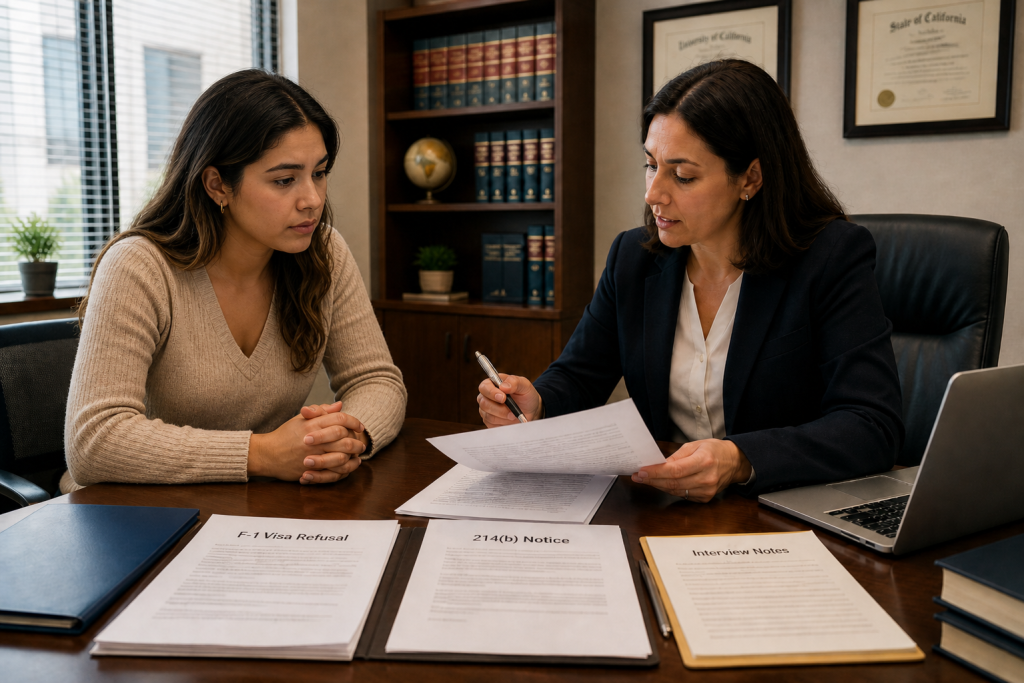
What an F-1 Visa Denial Lawyer Reviews First
An F-1 visa denial lawyer usually starts with the refusal notice, DS-160, Form I-20, SEVIS fee receipt, school admission letter, financial documents, academic records, prior visa applications, and interview history.
The review should also include what happened at the interview. What questions did the officer ask? Which answers seemed to create concern? Did the officer focus on finances, study plans, family ties, prior U.S. travel, work intentions, or the choice of school?
This matters because the refusal sheet may not explain everything. A short 214(b) notice often gives only a legal category, not a detailed explanation. As a result, the student must reconstruct the likely concern from the interview, the documents, and the facts.
If the problem involves broader F-1 planning rather than only the refusal, our student visa lawyer guide explains F-1 status, school documents, OPT, CPT, and common student visa issues.
What Does a 214(b) Student Visa Refusal Mean?
A 214(b) refusal means the consular officer did not believe the applicant qualified for a nonimmigrant visa at that time. The U.S. Department of State explains on its visa denials page that section 214(b) applies to nonimmigrant visa categories and often involves visa qualifications and immigrant intent.
For F-1 students, this does not always mean the officer thought the applicant was dishonest. Instead, the officer may have believed the student did not show a clear study plan, enough financial support, strong enough reasons to return home, or a credible reason for choosing that program.
A 214(b) refusal usually does not come with a formal appeal. In many cases, the student’s practical option is to reapply with a stronger, clearer case. However, reapplying too quickly with the same facts often leads to another refusal.
That is why the student should first identify what needs to change. The improvement may involve stronger financial documents, a clearer academic explanation, better interview preparation, or a more credible answer about future plans.
Why School Admission Is Not Enough
Many students feel shocked after a refusal because they already received admission from a U.S. school. That reaction is understandable. Still, the school and the consulate make different decisions.
The school decides whether the student qualifies academically for admission. The consular officer decides whether the student qualifies for the visa under U.S. immigration law. These are related, but they are not the same.
The U.S. Department of State explains the basic student visa process on its student visa page, including the need for a student visa for full-time academic or vocational study in the United States.
A strong F-1 application should connect the school, program, finances, and future plan into one believable story. If the student cannot explain why that school and program make sense, the officer may doubt the purpose of travel.
Common Reasons for F-1 Visa Denials
F-1 denials often come from a few recurring problems. The most common issue is a weak explanation of the study plan. The student may have a real academic goal, but the interview answers may sound vague, memorized, or disconnected from prior education.
Finances are another common problem. The student must show that tuition, living expenses, and related costs can realistically be covered. If the funding source looks unclear or unstable, the officer may question whether the student can study without unauthorized work.
Home-country ties also matter. Since F-1 is a nonimmigrant visa, the applicant must show a temporary study purpose. Weak ties do not automatically mean denial, but they can make the case harder.
Other concerns may involve poor school choice, inconsistent answers, prior visa refusals, a long gap in education, unclear English ability, or a record that suggests the student mainly wants to work in the United States.
How an F-1 Visa Denial Lawyer Reviews the Study Plan
An F-1 visa denial lawyer looks closely at whether the study plan makes sense. The officer may wonder why the student chose that degree, why the student chose that school, and how the program fits into the student’s future.
For example, a student applying for a master’s degree should be ready to explain how the program connects to earlier education or professional goals. A student changing fields should explain the transition clearly. A student choosing a lower-level or unusual program should expect more questions.
The answer should not sound like a generic brochure. It should be personal, specific, and credible. The student should understand the program, the school’s location, the costs, and the career plan after study.
This does not mean the student must promise a perfect future. However, the officer should hear a realistic academic reason for the trip.
Financial Evidence and Student Visa Refusals
Financial documents can make or break an F-1 interview. The student should show where the money comes from, who controls it, and whether it can actually cover the first year and future study plan.
Common evidence may include bank statements, sponsor letters, income proof, scholarship letters, loan documents, tax records, property or business records, and school cost estimates. The documents should be consistent with the I-20 and DS-160.
Problems arise when the sponsor’s income does not match the claimed support, when the bank balance appears suddenly without explanation, or when the student cannot explain who will pay and why. The officer may also question whether the student plans to work illegally to cover expenses.
A cleaner financial file does not mean more random paperwork. It means better-organized proof that matches the school cost and the student’s explanation.
Prior Visa Refusals and Reapplying
A prior refusal does not automatically prevent a future F-1 approval. However, the student should take it seriously.
If the facts have not changed, a second interview may end the same way. The student should review what changed since the last refusal. A new admission, stronger financial evidence, better academic explanation, new employment or family ties, or a clearer study plan may help.
The student should also answer prior refusal questions honestly. Trying to hide a previous denial can create a much more serious problem than the original refusal.
When the previous refusal involved only 214(b), the case may focus on strengthening the student’s visa qualifications. A refusal based on false information, fraud, or document concerns is more serious. For that type of problem, our misrepresentation waiver lawyer guide explains fraud findings, 212(a)(6)(C)(i), and waiver risks.
221(g), Administrative Processing, and Student Visas
Not every refusal means the officer made a final negative decision. Some student visa cases enter 221(g) administrative processing or require more documents.
In a 221(g) situation, the applicant may need to submit missing records, wait for security checks, provide additional information, or follow embassy instructions. The key is to read the notice carefully. The student should not treat every 221(g) case like a 214(b) refusal.
If the case involves administrative processing, missing documents, or a pending consular review, our 221g visa lawyer guide explains how 221(g) delays and document requests usually work.
A student should keep every embassy message, CEAC update, passport request, and document upload confirmation. Those records can help if the case stays pending or if the student later reapplies.
When USCIS Issues Matter in an F-1 Case
Most F-1 visa interviews happen through the Department of State at a U.S. embassy or consulate. However, USCIS may still matter in some student cases.
For example, some people already in the United States try to change to F-1 status instead of applying abroad. USCIS discusses student and exchange visitor classifications on its Students and Exchange Visitors page, including F-1 and M-1 student categories.
USCIS issues may also matter when the student previously changed status, filed Form I-539, requested reinstatement, applied for OPT, or had a status violation. Those facts can affect how the consulate views the later visa application.
Because of that, the student should not separate consular history from U.S. status history. The full record matters.
Interview Preparation After an F-1 Visa Denial
A second interview should not be a repeat of the first one. The student should prepare better, but not memorize fake answers.
Good preparation starts with the core questions. Why this school? Why this program? Who pays? What will the student do after graduation? Why study in the United States instead of another country? What changed since the last refusal?
The student should answer clearly and honestly. Short answers can work well when they are specific. Long, nervous answers can create confusion.
Documents also matter, but the interview is not only a paper review. The student must be able to explain the file. If the student does not understand the financial documents, school choice, or program structure, the officer may doubt the case.
Mistakes to Avoid After an F-1 Visa Refusal
The first mistake is reapplying immediately without changing the case. A fast reapplication may feel proactive, but it often fails if the same weakness remains.
Another mistake is changing the story. If the student gives a different explanation at the second interview, the officer may question credibility. A better strategy is to clarify the facts, not reinvent them.
Students should also avoid fake documents, exaggerated sponsor claims, and coaching that sounds scripted. These shortcuts can create serious inadmissibility issues.
Finally, students should not ignore timing. If the program start date is close, the student may need to defer admission, update the I-20, or coordinate with the school before booking another appointment.
How an F-1 Visa Denial Lawyer Builds a Stronger Reapplication
An F-1 visa denial lawyer builds the reapplication around the likely reason for refusal. The goal is not to overwhelm the officer with documents. The goal is to make the case clearer.
The lawyer may help the student organize a better study-plan explanation, review financial support, identify weak DS-160 answers, prepare for interview questions, and avoid inconsistent statements. When the case has prior refusals, the lawyer can also help explain what changed.
In some cases, the student should reapply quickly. In others, it may be better to wait until the facts improve. That decision depends on school deadlines, funding, personal ties, prior refusals, and any serious immigration concerns.
The best reapplication feels more credible, not more dramatic. It should show a real student, a real academic plan, realistic funding, and a temporary purpose that fits the F-1 category.
Conclusion
An F-1 visa refusal is frustrating, but it does not always end the student’s U.S. study plans. The next step depends on the reason for the denial, the strength of the record, and whether the student can fix the weak points before applying again.
An F-1 visa denial lawyer can help review the refusal, identify likely consular concerns, improve the study and financial explanation, and prepare the student for a stronger interview. In more serious cases, the lawyer can also help separate a normal 214(b) refusal from 221(g), fraud, misrepresentation, or prior status problems.
The key is to avoid guessing. A careful reapplication should answer the concern that caused the first refusal, not simply repeat the same case with a new interview date.
Disclaimer: This page provides general information, not legal advice. Immigration rules and procedures change. Always rely on current instructions from USCIS and the U.S. Department of State (linked above) and consult a qualified attorney about your specific situation.
Leave a Reply